
In his post “How to Kill Creativity” (in his blog “Slow Leadership”) Carmine Coyote shares the following graphic:
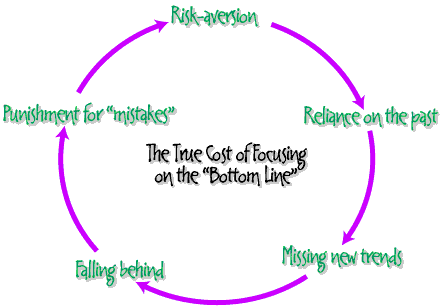
Carmine is talking about business contexts in his post, but can’t we see ourselves in this graph in education– especially if we think of the NCLB defined “bottom line” as student test scores? The “creative ones” seem to be the exception to the rule in most cases. As a group, teachers tend to be more gold than orange or green, if you’re familiar with the True Colors assessment.
One of the reasons I am coming to favor dynamical approaches to public policy issues including educational reform proposals is this need we have to unleash and empower innovators. Change agents are generally perceived as dangerous, however, so technocraticly inclined bureaucrats (and what government bureaucrat do you know who ISN’T technocratic by nature) don’t tend to like them.
Disruptive technologies threaten the existing order. Online education is, incidentally, inherently disruptive. It challenges the basic beliefs of traditional educational organizations, which hold that bricks and mortar are fundamentally needed for an educational experience. Many universities have moved toward online education (I was told at the SITE conference to quit calling it “distance education”) but I think this move is basically half-hearted for the institution as a whole.
Who are the risk takers, the innovators, and “the creative ones” in your organization or life sphere? How are they treated by others? The blogosphere can be a great place to hang out, think, read and write because like-minds can connect. It can bring someone like Nancy Pratt, who commented on a blog post earlier this month, into conversations she might not be in otherwise. But this brings us back to the idea and challenge of the echo chamber. Is this where the creative people are relegated? Is this where we have to live and stay?
I think not. We must take these messages of how new strategies and tools can be employed creatively to engage students and get them excited about learning “to the streets.” We must invite more educators into the conversation, to be part of the dialog. Do our organizations and many of our administrators inherently seem to avoid risk and discourage both creativity and innovation? Probably.
But let’s not let that stop us. 🙂
If you enjoyed this post and found it useful, subscribe to Wes’ free newsletter. Check out Wes’ video tutorial library, “Playing with Media.” Information about more ways to learn with Dr. Wesley Fryer are available on wesfryer.com/after.
On this day..
- David Jakes on Learning Spaces (April 2016) – 2016
- Scratch Camp Facilitator Workshop (April 2016) – 2016
- Understanding Why eBooks “Feel Different” – 2013
- Separate Wifi Access Point Works Best with Apple TV on Busy Network – 2012
- Tips for adding images to Custom Google Maps #gct – 2011
- How do you feel about students bringing laptops to class? – 2010
- Learners and teachers as tour guides – 2008
- Comments I had missed – 2007
- Rethinking WalMart Patronage – 2007
- Bill and Melinda are Terrified – 2006
Comments
4 responses to “Avoiding risk and discouraging creativity”
One minor point: I’m a “he” not a “she.”
Sorry, thanks for the correction. I’ve made the change in my original post!
Your theory is accurate save one item. Schools do not see the immediate punishment for mistakes. Only the students suffer them. Ill prepared for a technological world, they flounder with no repercussion on the school that failed them. The system can be better. It just isn’t ready for the innovations (or innovators) that are out there. We are virtually choked off from being innovators in the classroom. Judging by the posts of many other tech-savvy, blogging educators, it is a wide-spread problem.
I am a change agent, and I am disliked in many circles in education for that reason. I make administrators uncomfortable because I am always looking to push the envelope in my classroom. While my instructional ideas are sound, they are not traditional. And while I have won several awards for my teaching, it is only the state test scores they want to hear or talk about. I have considered what I do a challenge as opposed to a losing battle. With an IT guy that respects my attempts to affect a paradigm shift, I can at least relish the “black market” he provides me for equipment and software.
I am taking distance classes from UT-Arlington and love it. It is disruptive, but the challenge has been awesome. My district is part of a consortium that offers distance education classes for our high school students to earn high school credits. Unfortunately, we have an administration that discourages students from taking the courses because they do not want students to graduate early (thus losing money). So yes, we are part of an organization structured around avoiding change, stuck on the past, and inherently scared of transforming because no one can prove anything is wrong the way it is. I read recently (probably on your blog) that we must start with proving the system is not working. The challenge is when we have Exemplary and Recognized schools. They see no need for change. They are not forward thinking. While Friedman claims the world is flat, I claim it is transparent, and that scares the heck out of the educrats. Technology (especially Web 2.0) furthers that transparency to levels unheard of. It is easy to make claims of nothing to hide, but when the chance arrives to open the doors and let the world see inside, we as an education system avoid that chance. We can avoid the questions that just might make us uncomfortable. We will avoid the questions that just might make us improve. We can claim change, but if we are not uncomfortable in the process, are we really growing?
Weekly Roundup (16 April 2006)
Lots has been going on during my (brief) blogging break so it’s time to catch up! The break has refreshed me, allowed me to take stock, and hopefully the ideas I have for the blog will meet with the approval of you, my readership! Anyway, on with…