
I was quoted in a Dallas Morning News article yesterday titled, “Teen gangs find voice on Web.” The article highlights how students in gangs (and some possibly wanting to be in gangs) are using social networking spaces like Bebo and MySpace to express themselves, communicate with others, and share their voices with the world. (I am paraphrasing in a tactfully positive way.) They are also posting photos of themselves holding different kinds of weapons, along with threats and offensive messages. I think we need to coin a term for these types of news articles, but I am not sure what it is. The category might be something like, “The dark side of youth engaging in social networking.” The following is a quotation from the article:
These cyber-gangsters conduct online polls asking what color or gang teens represent. They arrange fights in person and rehash past victories.
One young user, who calls himself Jose, pledges his allegiance to the Sureños 13 gang: click click bang bang. In a blurry photo he stands holding what appears to be a rifle in front of a Mexican flag. “I represent that southside,” he writes. “So don’t run up and try all that wack [expletive] cuz I will shoot … ”
“Get strapped quik!!!” another teen writes. “I aint playin!!!”
Several teens responded to a reporter’s inquiry about their postings with profanity and threats. One wrote “duh we in a gang,” before bragging he was in an FBI book of pictures of West Side 12 gang members.
“I do this cus im proud of my family, my friends and mostly the hood,” wrote a 15-year-old who goes by the screen name “wstwix.” “it’s a promise that u keep 4 the futer generation how to protect ur neighbors show every body that were not punks that we are willing to die 4 la raza u know take a bullet 4 each other.”
This reminds me of my blog post from last night reflecting on proposed DOPA legislation in the United States. I wrote:
I think every school district educational technology department in the nation should have as part of its mission the regular publication of student work for the community so others can see the great work students are doing– and the power of using digital tools to collaborate and share ideas. School district PR folks should work closely with local media reporters and get them to cover the POSITIVE side of student social networking, and not just leave readers with the “scary predators on MySpace” side of the story.
Boy does that ever seen to be true in this case.
Katherine (the article’s author) quoted me fairly well, although she could have been more accurate in identifying me by saying I blog from “wherever I am on the planet” instead of insinuating I primarily blog during my day job:
Wesley Fryer, who blogs about technology in education from his office at Texas Tech University, said school districts can’t simply block Web sites out of fear – they must foster discussion on appropriate use. He compares it to avoiding talking about safe sex because of worries the information will encourage sex.
“Right now we see most school districts banning these sites but not addressing how they should be dealt with,” he said. “This is a conversation everybody should be having.”
To further extend what I recall saying during our phone interview– We need to help students, parents, teachers and others learn to safely navigate these virtual spaces. Just as we help young people learn to drive safely on the road, we need to help them learn to safely navigate cyberspace. Turning off the Internet is not an option.
The article includes the following info and statements from Irving ISD administrators:
For its part, the Irving school district already blocks access to social networking Web sites. But students get around the filters and are often online during school hours. Superintendent Jack Singley said such activity is an “inappropriate use” of the laptops that the district provides. But he also noted that it’s difficult to tell whether students are using their school computers or home computers to post….. Officials say they may also ban cyber-bullying – threatening or harassing others online – in their student code of conduct. “It’s a growth and maturity issue, not necessarily a public education issue,” Mr. Singley said.
If quoted accurately, the Irving ISD official position appears to be that “all digital social networking by students is inappropriate and not authorized.” Is that the official policy? I doubt it. Obviously news articles like these are bad press for any school district– but that is why I maintain schools should adopt proactive programs relating to digital social networking, and not remain purely defensive and reactive.
Unfortunately, both the Irving administration and the author of this article seem to assume that blocking all student access to social networking sites is natural, good, and reasonable. In my opinion, it is not. One reason, cited in the article itself, is that students access these sites from home and other locations. The adults in this situation seem to be ignoring the fact that digital natives live simultaneously in virtual and F2F (face to face) worlds. We cannot completely keep them offine, and we shouldn’t want to. If students are behaving inappropriately, then let’s deal with the inappropriate behavior and the underlying reasons for that behavior, rather than trying to just ban social networking websites and pretending that we’re doing our jobs as caretakers of youth.
I want to get an answer to the following question: What are our schools, our administrators, our teachers, our parents and our community members (because it does take a village to raise children) doing to help solve these underlying problems, and help students safely and appropriately navigate the virtual as well as F2F world? My guess is that most are not doing much at present.
The problems highlighted in this article do relate to technology, but I think they also DO have a lot to do with education. Technology is more the window to the issues and the problems, rather than the problem itself. That is why simply blocking social networking sites on school networks is an insufficient response. This response is analogous to a principal who hears a report about people in the community seeing students fighting inside the gym as they look through the window, and ordering the custodian to paint the window black so the public can’t see inside the gym from outside. Responses like this don’t fix problems, they mainly serve to mask them and challenge those involved to adapt to changed circumstances but persist in their same, problematic behaviors.
There are multiple problems identified in this article, some may be:
- Parents may not be communicating with their children as much as they need to, and may not be monitoring their children’s behavior away from home as much as they should.
- Young people are seeking identification and connections with others in their peer group, in the virtual world just as they do in the F2F world. Adults seem to be wanting to ignore the virtual world, however, rather than dealing with it through educational and other efforts. (Adults need to deal with the fighting and the reasons for the fighting in the gym, in the analogy I have used here, rather than painting the windows black.)
- School officials and even newspaper reporters seem to assume that banning social networking sites is an inherently good thing. Well, I have news for them. All the kids (and even adults) on MySpace are NOT gangsters! And they are not all gangster “wanna-bes.” The perception that everyone using social networking tools is a pedophile or a youth gang member is a real problem, because it is NOT accurate.
Katherine does acknowledge this to a degree, in the following 9 word sentence:
Most of the postings on Bebo are not gang-themed.
But what about the positive things happening in the edublogosphere? What about the social connections that students are making that are very positive for their literacy development, thanks to the laptops? I, for one, am sick of just reading these “dark side of youth engaging in social networking” articles in our newspapers, and not seeing articles about THE GOOD STUFF.
Should parents, teachers, and community members be aware of “the dark side” of social networking? Of course. We need to be informed and safe. But we shouldn’t think articles like this summarize the totality of benefit from digital social networking. That misperception would feed right into the reactionary, statists’ call for legislation like DOPA.
We shouldn’t just get upset about this, we should do something about it. We should write articles for the local press about the positive things students are doing with technology, including social networking, in schools. We should evangelize and advocate for great tools like Think.com. And instead of waiting for journalists like Katherine to write these articles (since apparently they prefer to keep writing about “the dark side,”) we should write them ourselves. I speaking to myself here as much as others.
It is fine to get upset, but I think we also need to decide what we can constructively do that will help address the issues that are upsetting to us. I think it’s time we wrote more news articles and opinion pieces for our local, regional, and national newspapers. Publishing in edtech journals and magazines is nice and useful, but these messages need to be aired in the wider world. Again I’ll repeat myself from last night:
Are we going to try and effectively surf the waves of change as best we can, or are we going to stick our heads in the sand while the tide comes in and washes away our sand castles? We need more voices in the political sphere sharing a vision of informed education on issues like social networking, cyberbullying and youth blogging. Despite the (apparent) ardent wishes of social conservatives, we can’t (and shouldn’t want to) ban the Internet. Yes we need to protect children, and yes we need to regulate the Internet, but we shouldn’t even seriously consider legislation that would have such a sweeping, chilling effect on read/write web collaboration, idea sharing, and expression.
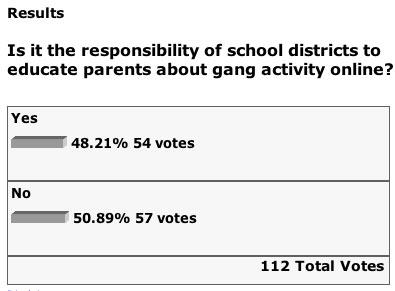
Interestingly, the 100+ respondents to the article’s accompanying survey are pretty evenly split about whether or not schools should help educate parents about what their children are doing online:
I think this is a shared responsibility. Parents can’t raise their children by themselves, and teachers can’t be expected to impart cognitive skills as well as build character in students without help from many others. Blocking and banning websites is not the solution here. We need to communicate and learn together, and tackle the really challenging issues which unfortunately don’t have simple solutions that can be legislated from on high. F2F conversations and dialog are the answers we need, not simple website bans at school.
If you enjoyed this post and found it useful, subscribe to Wes’ free newsletter. Check out Wes’ video tutorial library, “Playing with Media.” Information about more ways to learn with Dr. Wesley Fryer are available on wesfryer.com/after.
On this day..
- Starting an Audio Podcast (June 2023) – 2023
- Embed a Google DocList in a Google Site or WordPress Site – 2014
- Considering Options for LTE 4G Mobile Hotspots & iPhone Service (June 2012) – 2012
- Spirit of Oklahoma Storytelling Festival: June 3-4, 2011 @TerritoryTeller – 2011
- Oklahoma Educators: Become a Storychaser at OSU June 23-24, 2011 – 2011
- Digital reflections on an anthropologist’s journey to Kunming, China – 2010
- Web 2.0 Smackdown highlights from iConnect iLearn 2010 (Colby, Kansas) – 2010
- Tips and Tricks from Kevin Honeycutt #icil2010 (Colby, Kansas) – 2010
- A-Ha Moments: Voice (iConnect iLearn 2010 Opening Keynote) – First Prezi presentation – 2010
- Helping kids connect to their passions and become remarkable: SAVING money shifting to Project Based Learning – 2010
Comments
9 responses to “Blocking social networking sites is an insufficient response”
When I was still in the classroom teaching art I frequently had students who used the art media — pencils, acrylic paint, markers, paper, and digital software such as Adobe Illustrator and Adobe Photoshop — to create artwork that included gang symbols.
My response was to take up the artwork (to keep it out of circulation) and, if particular students repeated this action I was required (by law) to refer them to the gang task force officers.
However, I did not respond to this type of expression by banning ALL students from using the paint, pencils, and digital software. That would have been ridiculous — just as banning/blocking these websites is ridiculous.
I would also like to add — as someone who has spent the past 6 years working in an inner city school — that the Gang Task Force in our city has been tracking gang websites for several years.
Gang use of the internet did not emerge with the use of these social networking sites in just this past year — gangs have been creating static webpages, message forums, and other internet sites for years, and authorities have been tracking gangs through these sites for years.
Wes, you said: “I think we need to coin a term for these types of news articles, but I am not sure what it is. ” That term has already been coined, and the term is FUD.
When are people, especially the media, going to figure out that technology is not the problem — is not even the major enabler of the problem — and that banning the technology is only going to ensure the problem manifests itself in some other way? The problem is deeply rooted in a cultural dysfunction, and I guess it’s a lot easier to ban a website than it is to fix a culture.
I only scanned the article, but Katherine’s poll…”Is it the responsibility of school districts to educate parents about gang activity online?” Is it now, No “Parent” Left Behind as well? I need a pay raise! 🙂
The poll was a little obscure I thought?
In my opinion, it all comes down to this…a few “bad seeds” can ruin the entire crop. I believe that MOST students are using the internet in a positive way. I don’t think banning websites is the answer. I think parents need to take a more active role in their kids lives. Turn off the TV. Have a meal together and TALK for goodness sake! Kids act out because they don’t have an outlet or someone to talk to. I know that won’t solve all of the gang stuff, but perhaps you can prevent your kid from going in that direction. It’s not technology’s fault that we have kids killing eachother. I played cops and robbers when I was a kid and I shot stuff on my video games, but I have never even had a thought of shooting a human being or an animal for that matter. Heck I wouldn’t even know how to use a gun. Let’s stop blaming technology for all the problems and look in the mirror.
It’s frustrating to see the theme of troubles focused online. Gang activities has always been in issue. It should be no surprise that it is also something that appears online. This gang activities must be adddressed directly with prevention of gangs with the youth and help with those currently involved in gangs. This appearance of it on net is no reason to focus on internet restriction. It’s not as if we keep our students from going outside to avoid the gang members, tagging, MUSIC and much more out there.
The book my wife and I wrote, “MySpace Safety: 51 Tips for Teens and Parents,” might help turn the attention from negative to positive. We take the point of view that sites like MySpace are positive, as long as they are used responsibly. And we detail all the features of MySpace so that parents can know exactly what the site offers and how to instruct their teens on safe use.
Your copy is in the mail, Wesley. We published it as a softcover and as a downloadable PDF available at Amazon.com. And we have excerpts at our web site.
After months of work on the book, we find that MySpace itself has changed a lot (all for the better, in our opinion). Yet the debate on MySpace and online social networking has in some ways gone in an even more harmful direction than the “predators” debate that was prevalent when we started writing the book in February.
It’s hard to believe the DOPA legislation. At first I thought it had to be just political posturing. But apparently it was much more than that…
[…] Blog Name: Moving at the Speed of Creativity Article Title: Blocking social networking sites is an insufficient response I was quoted in a Dallas Morning News article yesterday titled, “Teen gangs find voice on Web.” The article highlights how students in gangs (and some possibly wanting to be in gangs) are using social networking spaces like Bebo and MySp… […]
[…] Some of our political leaders are recognizing the power of digital social networking and digital storytelling tools like YouTube to share information and influence others. Why do so many school leaders seem to be pretending the web 2.0 Internet does not exist? The most obvious answer is that objectionable content is accessible from websites like YouTube– so to comply with CIPA and protect networked Windows-based computers from downloadable security threats, the guardians of school networks often block access to these sites. I continue to maintain, however, that merely blocking sites is an insufficient response to the realities and opportunities inherent in dsn. […]