
Not everyone is going to be lucky enough to work for an innovative and wildly successful (at least in financial terms) company like Google. Despite that fact, Google’s success and the managerial philosophy of its leaders provide worthwhile object lessons to which more people in business as well as education should pay attention. The May 2007 issue of Wired Magazine includes an interesting interview with Google CEO Eric Schmidt. For more on Eric’s background, check out the current version of his WikiPedia article.
In the Wired interview (on page 174 if you have the analog/print version) Eric responsed to several questions which reflect the essential role COLLABORATION plays in the daily work of Google employees. He was asked:
Google’s revenue and employee head count have tripled in the last two years. How do you keep from becoming too bureaucratic or too chaotic?
His response:
It’s a constant problem. We analyze this every day, and our conclusion is that the best model remains small teams running as fast as they can and tolerating a certain lack of cohesion. The attempt to provide order drives out the creativity. And so it’s a balance.
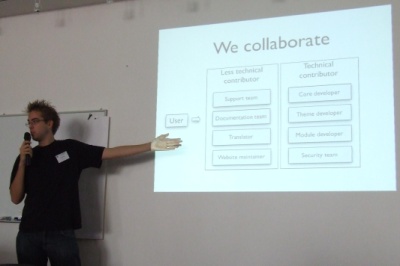
Note his language: “..the best model remains small teams running as fast as they can and tolerating a certain lack of cohesion.” This connects directly to what we need to see MORE in the classroom, but many classroom teachers (as well as building administrators) don’t feel comfortable with: The noise/hum of collaborative learning and discussion. Teachers are often not comfortable “letting go” of the sense of control they have when lecturing to a largely silent classroom of listeners. The lesson here is that the business world does not merely want to hire listeners and fact regurgitators, but rather thinkers who can collaborate, “run fast” and create innovative ideas which reflect both higher level thinking as well as creativity. Another question posted to Eric was:
Google is a global corporation. What do you do to make employees in other countries all feel like they are working here in Mountain View?
His response:
It’s a great unsolved problem. We do videoconferencing; we do a lot of visits where people are invited to one of the main campuses for a month or two. So they feel a part of a bigger entity when they go back. And that model does work. Of course, we do all the normal meetings – the sales meetings and training meetings, and all that. More and more of our time is being spent on that.
From this response, we can identify some key activities which can and should be ubiquitous in our classrooms. Prominent among these activities is global collaboration. (Think K-12 Online Conference 2007.) As Scott Mcleod documented effectively in graphical form in December 2006, the vast majority of schools in the United States are wired for broadband Internet access. Unlike the mid to late 1990s, getting our schools “wired” is no longer a challenge. Getting the learners inside our schools to USE those wired connections for actual COLLABORATION rather than just information consumption (Internet research and other non-publishing activities) is the continuing challenge.
In a flat world, the biggest financial rewards will increasingly go to those who collaborate effectively, as well as those who innovate. This is a key theme of Tom Friedman’s book “The World Is Flat: A Brief History of the Twenty-first Century.” I do not view education as purely a means to provide for economic development and vocational opportunities, but I certainly acknowledge the important role education plays in opening up (or closing) doors of economic opportunity for individuals as well as communities.
My dad has recently been involved in discussions with groups in Kansas as well as Nebraska related to the HomeTown Competitiveness Initiative. There are multiple facets to the project, but an essential focus is how we can revitalize rural communities in the United States. This revitalization has an important economic aspect, but also has other aspects including political ones. I am particularly interested in the educational aspects. The project has four key foci:
– leadership
– charitable giving
– entrepreneurship
– youth
The Center for Rural Entrepreneurship has created the Energizing Entrepreneurs website as a companion for their book “Energizing Entrepreneurs: Charting a Course for Rural Communities” by Deborah Markley, Don Macke, and Vicki Luther. I have not read the book and am not yet well versed on their ideas and initiatives, but am intrigued by the linkages which should exist between many of the discussions we are having here in the edublogosphere regarding educational reform and school 2.0, and these groups focused on rural community revitalization. The Heartland Center for Leadership Development in Nebraska is sponsoring a conference in June focusing on entrepreneurship which sounds interesting, and there are clear connections here to educational reform as well.

Kevin Honeycutt shared last week in his presentation at KSDE 2007 his conviction that the collaborative and creative potentials latent in the flat world digital technologies now at the fingertips of every Internet user on the planet have the potential to revitalize small-town, rural America and reverse long-standing demographic trends of rural to urban population shifts. Is Kevin right? I suspect he is.
If he is, the key ingredients we need to realize these potentials are LEADERSHIP and VISION. We need leaders with the vision to understand that collaboration and project-based learning must become ubiquitous in our schools, instead of a rare occurrence which can only take place in late Spring after the statewide mandated assessments are finished. We need an educational reform agenda which discards the destructive and counter-productive focus we’ve had for too many years now on high-stakes standardized testing, and replaces it with a truly student-centered, constructivist agenda that embraces diverse modalities for learning as well as assessment. Importantly, this vision needs to reject the ridiculous idea that yet MORE standards, more requirements, and greater threats of punishment in our schools will bring about the creative and revitalized educational culture which should be the RIGHT of every learner in the 21st century. TIME remains the greatest obstacle to any educational reform proposal, and anyone serious about educational reform needs to be talking about educational deregulation instead of more tests and threats.
Is this vision present within the members of your own local school board? Among the upper echelons of leadership in your school district’s staff? Within your local PTO/PTA leadership team? In the halls of your state legislature?
I don’t know, and I don’t know if this vision is present within the “HomeTown Competitiveness Initiative” and related projects, but I sense some good opportunities here for synergy and collaboration. Every civic and community leader, regardless of the size of their town or city, should be vitally concerned about the ways schools need to change to meet the needs of the 21st century information and economic landscape. Perhaps some of these regional initiatives focused on rural revitalization and entrepreneurship will provide fertile ground for ongoing discussions about school 2.0?
Sounds like some good topics to take up at your local Rotary, Lions, or other civic club’s next meeting. Will you take on the mantle of leadership for your local area and encourage these types of conversations to take place? If they don’t start with you in your local community, with whom will they start? Will those needed conversations take place at all? You don’t need to have all the answers, but you do need to be able to ask some good questions. Here are some suggestions to possibly get you started:
- How are our schools encouraging students and teachers to regularly collaborate with other learners around the globe every week of the school year?
- How are we providing more time for our teachers to obtain continuing professional development training and support each other in the innovative uses of technologies to improve learning and make global connections?
- How are we seeking to foster educational cultures of creativity, innovation, and flat-world thinking in our schools?
- How many project-based learning challenges and opportunities did your own children or grandchildren in our public schools have this month? This school year? (Think of Eric Schmidt’s words about small groups “moving fast” in this context.)
- Who are the educational leaders in our community who are advancing a vision of ubiquitous global collaboration for learning inside and outside of our schools? How can this vision become a transparent part of how we “do school” every day?
Technorati Tags: economicdevelopment, economics, education, educationreform, leadership, learning, politics, ruralrevitalization, school2.0, schoolreform
Note: As of 1 Oct 2026, this is a FULL STATIC COPY of all 6,390 posts shared on this blog since 2003. Updated content and ideas from Wes Fryer are still available!
Comments
10 responses to “Collaboration in schools: More reasons we need it”
In your questions, I think you hit the key. If teachers don’t collaborate themselves and feel comfortable doing that with a variety of people, then they will feel comfortable having collaboration in their classroom. How long is it going to take to get teacher’s out of the industrial age model? It will continue as long a it is allowed to by school administrations and school visions allow it. Parents and legislators have to be shown why collaboration is imporatant and why school should look like it did when they attended.
That is quite a challenge for all of us. I will continue to work on it and let you know how the answers came to be.
Wes said…
This connects directly to what we need to see MORE in the classroom, but many classroom teachers (as well as building administrators) don’t feel comfortable with: The noise/hum of collaborative learning and discussion. Teachers are often not comfortable “letting go†of the sense of control they have when lecturing to a largely silent classroom of listeners.
Having looked at this through several lens- teacher, building administrator, district office admin, and teacher prep (university)– I have to say that the place re-culturing needs to start is at the teacher prep and central office levels. It has been my experience that teachers are naturally collaborative, however, they tend to set up their classrooms by modeling what they see in their university prep classes and then continue modeling what is expected from on high. I agree it is a control issue, school is all about control. But I strongly feel if we would quit controlling teachers- then they would lead the way in modeling true creativity and collaboration in curriculum delivery.
I mean if you teach ask yourself: Does this row and column, everyone in the same place at the same time thing feel natural? Do you run your homes like this? If the chains upon you were removed and you felt you could truly set your classrooms up any way you wanted without fear of negative retribution– would you do what you are doing now?
I know I wouldn’t!
Wes – have you seen this yet?
http://learningismessy.com/blog/?p=254
Ever since you had me iChat into one of your sessions last summer – and we did a few Skypecasts, I’ve been looking for ways to use Skype, wikis, Flickr, etc. to “go global” with my students. There are some obvious obstacles like time zones for Skype, however Lee Baber and I have linked up twice now – I know her students are collaborating with students in New York – Vicki Davis has been doing some great collaborative pieces and there are others … we’re slowly getting there – and the more people that come online the more people there will be to collaborate with.
Hope to see you at NECC 2007
Brian
I love online collaboration — in fact, I have been hosting project since 1999 just go get teachers involved with working together. And this year, we had over 52,000 students (and their teachers) participating in 10 online projects.
It is interesting to me though — how K6 projects continue to get overlooked as effective and necessary projects and that the higher level projects get more noticed. Grins, not that I am jealous — Vicki is a dear dear friend.
However, I do think that if we catch them when they are young — Kto4 is my real passion — then we have set a precedence for them to follow in the future.
Perhaps the elementary online projects are not as sophisticated or noticed as the older ages — but we are collaborating through groups, blogs, google earth, photoshares, wikis, and more. Grins, and one day, hopefully, we will be noticed for our contribution and laying the foundation for older age projects.
Hugs to you my friend!
Jennifer
ps — thanks for letting me rant.
Yes, but Sheryl, it is also about being polite. I find it very rude of anyone to talk while I am addressing the group, especially every lesson has built in “talk” time. We do need to collaborate and let go, but all stake-holders need to be aware of other’s needs and need to display the appropriate etiquette for the situation.
Wes, your posts are always so thought provoking! I really appreciate being able to listen to them as well. One of these days, I will have time to play with the Talkr and get that link right on mine.
Jen – I know the primary kids (PreK too) get so excited with just hearing their voices on my computer. They don’t really care about the podcasts…but that will come. I hope to get some of our primary classes involved in one of your projects next year. We have to remember, and I have trouble with this, that we all have embraced the web2.0 tools and others have not even embraced the web1.0. We persist….
Great ideas, Wes! I had the exciting opportunity to visit Google Campus in Mountain View last summer – what a culture! Employees have 20% of their time to explore new projects on their own – TWENTY PERCENT! Think of the possibilities of teachers had that much time to create and innovate! For more about how corporate culture is embracing this new model of openness and mass collaboration, I recommend the book “Wikinomics” by Don Tapscott and Anthony Williams.
And you are right about leadership needing vision for collaboration. While I know many who are venturing out with projects in my online connections of peers, I don’t know anyone in my immediate context, besides myself, who is doing online collaborative projects. We need to get the word out!
In addition to blogging, wikis are my favorite for social networking. The wiki space allows faculty to help each other, for example, schools could set up a mentorship program for beggining teachers through wikis. Also, the wikis are great for global education, allowing students to have their own wiki space or participate in a class wiki sharing their cultural backgrounds. I agree leadership does need vision for collaboration and wikis are very simple to set up.
Once again, Wes.. we’re thinking alike! If you get a chance, read my latest post, The Sweet Sound of Learning.