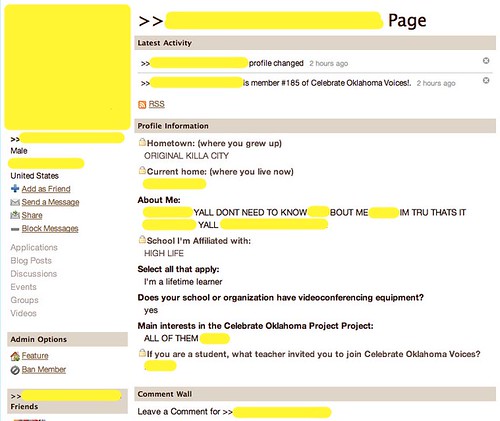
Perhaps this was inevitable. This evening we had our first instance of a student creating a profane and inappropriate account profile in our Celebrate Oklahoma Voices learning community, and posting a profane comment on the profile wall of another student member. I’ve used Skitch to hide the identifying information of the student in question in the screenshots below, because I want to highlight the issues and challenges this raises rather than stigmatize a student, teacher, or a school.
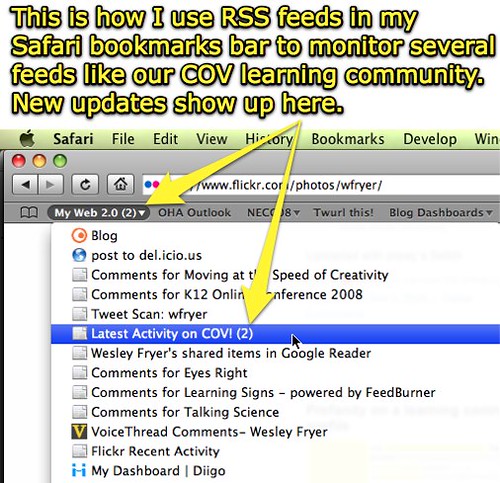
Thanks to the RSS feed I keep in my Safari web browser’s bookmarks bar notifying me whenever there is new activity in our learning community, I learned about this profile and the inappropriate comment the student left for (most likely) a classmate about an hour and a half after it happened this evening at 6:30 pm CST.
This led to about an hour and a half of work on my part taking the following actions:
- I took screenshots with Skitch of the user’s profile page and the comment they left for another user.
- I deleted their comment and banned the user from our Ning site using my administrator tools. (It turns out I didn’t need to delete their comment manually, by banning their account from the site all their contributed content on the site also was automatically deleted.)
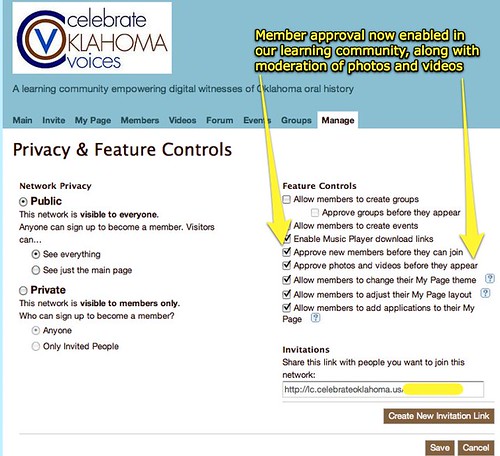
- I enabled account approval on our Ning learning community, and also enabled media moderation (for posted photos and videos) on our site.
I also sent a message to the student who had received the profane comment, letting them know what actions had been taken and asking them to have their teacher contact me.
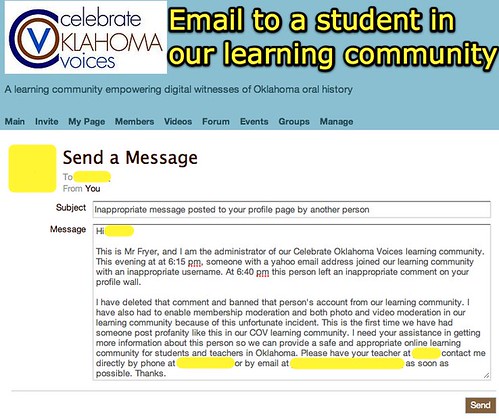
Based on context of the profane comment that was left, it was not difficult to hypothesize the school they currently attend and the teacher at their school who has attended our COV workshop in the past. My Ning administrator site management interface for user accounts shows me the email address of that user (now banned) and I composed messages to the teacher that I sent both via Ning, and via regular email. I sent unmasked versions of the screenshots I’d captured to the teacher. This is the email I sent to the teacher, with identifying names removed:
Hi [TEACHER FIRST NAME]:
I’m sending you this email to provide documentation which may assist you in investigating the identity of a student (who I suspect is from [NAME OF CITY]) who created a profile with profane and inappropriate language this evening on our Celebrate Oklahoma Voices learning community website, and left an inappropriate comment on the profile of another [NAME OF CITY] student. For your own documentation and mine, this is the message I also sent you this evening as a message in our Ning learning community:
— start of message —
Hi [TEACHER FIRST NAME]!
This is Wesley Fryer, co-director of Celebrate Oklahoma Voices and one of the administrators for our online COV community. Let me first say I am DELIGHTED that you have students who have created oral history interviews and digital stories, and are sharing them on our website! That is great!
This evening we did have a student, who I suspect is from [NAME OF CITY] based on the profile info he/she entered, create a profile using profanity and inappropriate language. The student also left another inappropriate comment on our learning community site for another [NAME OF CITY] student.
I have recorded screen captures of these posts, deleted them from the learning community, and banned the student’s account. I also have enabled account moderation and photo/video moderation on our site. Perhaps this was inevitable, but this is the first instance of profanity and inappropriate language we’ve had on our site to date.
I am going to email you copies of the screenshots which include the student’s email address, and the account of the person who they left the inappropriate comment for. If you could, it would be good if you can find out who this person is and use this as an opportunity to discuss digital citizenship and appropriate uses of online learning communities. We know this kind of thing is going to happen, and it is good for us to be able to talk about this with students and learn from these situations.
I will email this to you at the account I have on file for you, which is [EMAIL ADDRESS]. I will email you from [MY EMAIL ADDRESS]. You can call me at [PHONE NUMBER] to discuss this if you want. I will help you in any way I can to help investigate and deal with this situation.
Again, the participation of your students from [NAME OF CITY] in COV is GREAT and I don’t want you to think that this incident will in any way reflect poorly on you or your school. These kinds of things are going to happen and we’ll work together to deal with them.
Wes
— end of message —The email address this person/student registered with was [STUDENT EMAIL ADDRESS]. As you can see from the attached screenshots, they did not use their full name when they registered. (Not surprisingly, they apparently wanted to remain anonymous, but did apparently use their real email address.) I strongly suspect they know the student with the account “[OTHER USERNAME],” since that is the person they left the comment for. You might (or your principal might) start your investigation by interviewing that student privately about the identity of [STUDENT EMAIL ADDRESS].
Please contact me if I can be of more assistance, and also let me know you received this email. I’d like you to please follow up with me by phone when convenient (no rush) so I can learn what you found out and were able to do. We are all learning in this new environment– While situations like these are unfortunate they are going to come up and I will work togther with you to help in this situation.
I would suggest you get your campus principal/administrator involved in investigating this situation, so you can have their support and they will know/understand what is going on. With account moderation now enabled I anticipate our incidents like these will be minimized, but there is no telling what will happen.
I have NOT contacted this student directly through our learning community or via email, nor do I plan to– I am going to leave that up to you and your administrator. I have (as I stated above) deleted their comment and profile from our learning community, and banned their account (registered with the email I mentioned above) from the learning community.
On a positive note, I saw on your learning community profile that you’re interested in doing more with Veteran history, so I wanted to be sure you know about [ADDITIONAL INFO ABOUT AN UPCOMING VIDEOCONFERENCE DELETED].
Thanks
One of the first thoughts that might enter your mind as an educator or parent might be, “Wouldn’t it be easier if we just banned or prevented students from joining and participating in a learning community like this?” The answer to that, of course, is “yes.” However, we NEED to have conversations about appropriate uses of online learning communities like this with our students. If we never provide students with opportunities to engage in appropriate social networking in contexts like this, how are we all going to learn how to practice digital citizenship? We have to “get in the water” if we are going to learn how to swim.


While it has been great to be able to leave our learning community website open to registrations from anyone, it does make sense to now moderate accounts as well as submitted photos and videos as the profile of our project moves beyond teacher professional development and involves more students and community members.
Do you have any suggestions for things I should have done or still should do with regard to this incident? I’m sure we are all going to learn a great deal from this situation. Hopefully the learning we experience and share can benefit many. This is a good conversation to be having about 21st century communication and collaboration.
Technorati Tags:
ning, collaboration, moderate, moderation, inappropriate, socialnetworking, student, school, ban, block, teacher, administrator, leadership
If you enjoyed this post and found it useful, subscribe to Wes’ free newsletter. Check out Wes’ video tutorial library, “Playing with Media.” Information about more ways to learn with Dr. Wesley Fryer are available on wesfryer.com/after.
On this day..
- The iPad Mobile Manager Saved My Life Today – 2014
- Is AT&T Mobile Share with Unlimited Talk & Text A Good Deal? – 2012
- Google Reader Post Sharing Still working with Mobile RSS – 2011
- Oklahoma Students Discuss Creativity, Art, Computers, Legos, and School Improvement #CWF2010 – 2010
- Education in Oklahoma 2010 Elections: Barresi wins, 744 defeated – 2010
- Creativity and Innovation in Chinese Society and Schools – 2009
- Archived Keynote and Co-Presentation with Miguel – 2007
Comments
7 responses to “Navigating challenges of public learning communities for students”
Hello, Wesley,
At the outset, the communication you lay out is the central piece of managing a community — it definitely requires a human, personal touch.
Some technological wrinkles that can augment the personal touch (and I don’t know whether these are possible in Ning or not):
1. Create a placeholder role for students without rights to comment on profiles; once they have made a small number of posts (say 3-5) in the site, they are elevated into the full role with full responsibilities.
2. Create a mechanism to flag specific words, and put those posts into moderation;
And again, with that said, I often hesitate before advocating for technological checks on human behavior — people learn from mistakes, and without the freedom to choose the wrong path it’s more difficult to learn the judgment required to make the correct choice.
Your post caught my eye so I hope you don’t mind me coming out of left-field. As someone with experience in fostering online community (but not in working with students), I like the way you caught and handled this. Monitoring your own RSS feed and documenting everything is very smart. And I like that you start off the letter to the teacher by praising student participation even if this instance wasn’t what is desired.
Should this happen again, would it be appropriate to not ban the student, but remove the offending material and prevent him or her from posting until the teacher can have the conversation you suggest? Or would you be willing to allow that particular email to return to COV if they sent you an apology and did not again post offending material?
Of course, there may be particulars that prevent offering this additional help such as restricted contact with students (minors), intent of the site, or the resources available.
It’s the harder path to follow, I know. I’ve spent many hours trying to reform people who post inappropriate material. I guess I recommend it because when someone does turn around (and it does happen), they often try to teach others what is appropriate for the community.
Thanks for documenting your process in such detail. It’s something that I rarely see when people blog about moderation/facilitation methods.
Thank you, this is a good way to deal with what will surely be a situation bound to be repeated. Perhaps rather than banning them from the community, as this can have disastrous effects, it would also be possible to monitor all further postings from this student for a period of time. They need to keep saying things – even if we don’t like what they are saying, and guided further along the path towards some sort of enlightenment, if possible. Reading the actual comments written also gives a little understanding of their “emotional” state when they were posting. Understanding leads to empathy. I hope they a soft touch glove to help students who post about being “high” at that school, and a warm support circle to embrace them!!!
Smart way to seize the teachable moment for everyone involved. Thanks for sharing some sanity about this topic!
I would like to see this student able to participate in the learning community in appropriate ways. Given the username s/he had selected, however, banning their account seemed like the best decision. They can create another account with a different userid and pw of course, but now those created accounts will be moderated in an approval queue.
We are working with a developer to build a more robust learning community in Drupal and will be sharing more about that in the weeks and months ahead.
Wesley, thanks for clarifying that the username was also inappropriate. Removing the user account makes more sense now. I also managed to assume that the ban included preventing the email address from starting a new account which is an error on my part.
Let’s hope that the student does return and participates in a way that is appropriate and allows everyone to benefit from the interaction.
[…] has been written about the changing needs of students in the 21st century and the transformation that must take […]