
One of the paradoxical results of our politically-imposed focus on high stakes accountability and test scores in U.S. K-12 public schools is that many teachers and students have their eyes on minimum standards rather than exceptionally high expectations for each student’s learning and growth. Arnold Toynbee’s quotation of the day from my iGoogle portal resonates with me in this context:
It is a paradoxical but profoundly true and important principle of life that the most likely way to reach a goal is to be aiming not at that goal itself but at some more ambitious goal beyond it.
High expectations are essential for high levels of student achievement, which most educators as well as parents would agree is a desirable outcome of a student’s years in K-12 education. NCLB has failed miserably to inspire students and teachers to have high expectations, however, because the initiative is all about minimum standards. (See my February 2008 post, “A contrary view of education and NCLB” for more of my thoughts along these lines.)
As I continue my work as a 21st century educator, I grow increasingly convinced that the fundamentally coercive nature of our public education system in the United States must change in basic ways. We, as a society, have grown accustomed to an educational system which is compulsory and therefore fundamentally coercive in its nature. This coercive side of education becomes most clearly unmasked in May, as we draw closer to the end of school. Students sitting in class a week from the end of school may understandably ask, “Why are we here?” After my presentation about safe online social networking and Internet safety today in an Oklahoma elementary school just south of Oklahoma City, I walked by a classroom of silent students watching a video on the television while the teacher sat at her desk and worked on paperwork. I am certainly not averse to teachers working on paperwork while students are working and learning in school, but the scene struck me as absurd because of the learning and fiscal dynamics at work before me. Although teachers, students and parents are ostensibly focused on test scores and minimum performance standards, state legislatures like ours in Oklahoma continue to pay schools for SEAT TIME. How many days have you had students warm seats in their classroom? Based on this formula, state funding dollars are allocated to our schools. If an adult was honest with the students sitting quietly watching a video in that Oklahoma classroom today, in response to the question “Why are we here?” that person might respond:
We are here so our school gets paid for you sitting in your chair and warming your seat. It really doesn’t matter what you do or do not do, as long as you are not disruptive or hurtful to others in our classroom. Since it doesn’t matter what you do, we are going to do the easiest thing possible from a teacher and administrator perspective today: We are simply going to show you full length videos. No matter that we are violating both the spirit and letter of US intellectual property law in showing you full-length commercial movies which we have obtained under the auspices of private, home-only viewing or limited uses for purposes of critiquing excerpts of the film for authentically educational purposes under fair use provisions of copyright law. We are not showing these films to inspire you to think critically or analyze the more poignant issues raised in the movies, we are simply trying to keep you quiet and happy like cattle or pigs in a feed pen. If you are entertained, that is fine, but our main goal is to keep you here and keep you quiet. Since our state tests are over, we are not focused on helping you become more educated or literate. Like prisoners in a prison, we are all here “doing time” until the clock and the calendar says we can all go home. Our school will not receive the money we need unless you are here, and we are focused on minimum standards. So: Please stop asking questions, please stop thinking critically, please stop talking and thinking AT ALL and go back to sitting quietly, watching the movies we are showing you like the good, passive, compliant students we have done our best to condition you to be this year at our school.
I haven’t ever heard an adult actually share that answer with students, because the harsh truth in those sentences is possibly even more cynical than some educators are willing to voluntarily acknowledge. Of course this generalization is NOT appropriate or fitting for all classrooms, in all educational contexts. It IS accurate in many settings, however, and I find the prevalence of this situation both disturbing and personally motivating from an educational advocacy perspective.
Coercive schooling is quite often BAD schooling. Let me be clear: I am NOT advocating that we abandon all rules and boundaries in our schools, or that we let every student do exactly as he or she pleases inside or outside of school. That would be anarchy. Advocates for more student-centered approaches to learning are too often mistaken for social anarchists, I think. Last week when I presented at ESC10 in Richardson, Texas, I talked with a technology director about his perceptions of the video, “Learning to Change, Changing to Learn” from COSN. He responded by saying he was really “old school” and “traditional,” and thought that kids needed to be MADE to learn and follow rigid rules in the school. I had just watched the same video as this technology director, and I did not understand the authors to in any way imply or suggest that schools should abandon their rules. What I DID hear the contributors say, again and again, is that schools must become more truly learner-centered and empower students to develop the type of independence and initiative which is both valued and expected by employers in the 21st century workforce. Schools need to help students develop and cultivate relevant skills, and stop focusing so much attention and coercive effort on making students memorize and regurgitate facts.
Coercive school culture is revealed clearly at the end of the school year in other ways besides teachers simply showing students full-length commercial movies in class. In one nearby school district, students are being required to attend class the Tuesday after the Memorial Day holiday. The enticement to get students to school that day? Report cards are being withheld unless students come to class.
Another recent example of coercive school culture involves “AR.” The Accelerated Reader (AR) program from Renaissance Learning has been used well but also used poorly by teachers in many different schools since its inception in the 1990s. The formula for helping students join “the literacy club” and become lifelong learners who love reading and literacy is well established in educational research focused on student literacy, according to Dr. Stephen Krashen, and does NOT have anything to do with computer technology or book quizzes. The formula for lifelong readers is: Provide students with robust access to diverse types of literature, and provide them with lots of TIME to read. As students self-select texts and select texts with the assistance of peers and teachers, they will grow in their abilities to not only read but also to write– because the research supports the contention that we learn to write better mostly be reading. The AR program, which involves students taking a computerized comprehension test after they read a book successfully, by its very nature encourages an instrumentalist attitude toward reading which focuses on extrinsic rewards. It is true some students are motivated by these extrinsic AR rewards, but it is misleading to suggest that students are best served by giving them carrots for reading– which is an experience that INTRINSICALLY holds and provides its own rewards. After students leave a coercive classroom environment where they are given toys, prizes and even parties including jumping castles for reading books, they will rarely (if ever) encounter a similar environment again. In the world of business and work, being literate and well-read certainly has its rewards, but they do NOT come in the form of shiny prizes or food bribes.
I was recently in an Oklahoma elementary school where students who have not earned “enough” AR points at school are not allowed to go outside and play for recess. Instead of going outside to play (being afforded the precious gift of unstructured time in a natural environment) students are PUNISHED by being forced to read. Some educators claim “this is not punishment” since the kids are being allowed to read books of their choice, but the perception of the children in this case is the key determinant. The kids perceive this forced reading as “punishment” since they would rather be playing at recess. I think we all should be encouraging people of all ages to read more and more often, but the last thing we should do in our schools is use READING as a punishment. This is as stupid and ill-founded from an educational research standpoint as using WRITING as a punishment, which is also still sadly common in some of our schools. Yes, we are living in the 21st century, but in some of our classrooms, the methods employed to ostensibly MAKE students learn and “get what they need” for life success is coercively medieval.
I deeply desire change in these sorts of coercive and harmful educational environments. Rather than being forced to sit quietly and watch movies in class the last week of May, like every other week of the school year teachers should be inviting and challenging students to engage in meaningful work for an audience which extends far beyond the four physical walls of the classroom. Rather than acting like prisoners and prison guards, students and teachers in our schools in May and every other month of the year should fulfill the role of this wonderful sign, which I blogged about last year in August:
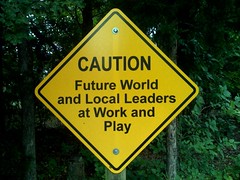
We must move beyond our current school finance systems which pay school districts based on seat time. We must embrace political leaders who inspire learners of all ages to strive for high expectations, appropriately differentiated to the interests and abilities of individual students. We must find ways to completely transcend the coercive nature of public education, and replace that culture with one where innovation, creativity, and inspired excellence can thrive. To fail in this task is to fail our children, their future and our own. We simply must do better than we are in many cases in our U.S. public schools.
Technorati Tags:
education, school, reform, change, web2, learning, leadership, coercion, punishment, acceleratedreader, krashen, stephenkrashen, literacy, research, politics, nclb
If you enjoyed this post and found it useful, subscribe to Wes’ free newsletter. Check out Wes’ video tutorial library, “Playing with Media.” Information about more ways to learn with Dr. Wesley Fryer are available on wesfryer.com/after.
On this day..
- MinecraftEDU student computer (client) configuration – 2014
- Google Chrome & Homebase” Computer Lab Setup – 2014
- Load Saved MinecraftEDU World on School Server – 2014
- Reflections on Graduation Rituals, Celebrations, College Debts and a Ph.D. – 2012
- Wow – 2010
- Summarizing copyright and fair use with a mashup of Disney movie clips – 2010
- links for 2008-05-19 – 2008
- Video in schools and underlying pedagogies – 2006
- Google Trends and Data Analysis – 2006
- No cross-post this week – 2006
Comments
15 responses to “Looking beyond coercion, tests and seat time”
Yikes!You might also hear the argument that teachers have a contract to live up to and must fulfill their number of school days as well as student fulfilling seat time.Maybe not the best example, but an example.
Here is how I envision my end of the school year. We don’t end until mid to late June.
Teachers close all grades.
______ Camp. You choose, science, geography, math, literature.
Everyone is engaged in camp like activities for their instruction on the topic and theme.
We chose estuaries one year and included music, physical education, poetry, literature, science experiments, geography.
We had cook outs at lunch.
Popsicles at the end of the day.
Crafts about the subject of the day.
Everyone wanted to come to Camp!
Teachers planned a lesson per day and then students cycled through the classrooms or outdoor rooms.
Now that is engaging! * not one movie!
Well said. It made me think of a funny yet sad anecdote that educational consultant Larry Lezotte tells at his workshops: a principal is showing him around the school. Larry notices a sign that says “Attendance Office.” Larry jokingly says to the principal, “Where’s the Learning Office?” The principal, not joking, answers, “Learning Office? What are you talking about? There’s no money in learning!”
Wes,
Yikes! I’d never really thought about this… Very insightful – and it should be inciteful! One question – are the first 8.5 months of the school year much better?
Great post!
[…] by Rick Tanski on May 19, 2008 This post started out as a comment on Wes Fryer’s Looking beyond coercion, tests and seat time post from May 19. I found myself with rather a lot to write about on the topic and didn’t think it […]
Wes,I started out with just a few thoughts to respond to this topic and wound up with an entire post. I didn’t think it appropriate to post the entire entry as a comment, so here’s the link. http://ricktanski.wordpress.com/2008/05/19/coercion-through-competition/. Your thoughts fall right in line with a book I’ve been reading, Unencorporating Education by Dr. William Cook, Jr. Here’s part of the book that meshed with your entry here; and as a result, got me going… “The purpose of education in a free society must be to liberate the full powers of the individual toward the common good…The common good is not served by the loss of any person…No democracy has any business accepting, much less supporting, any endeavor that does not hold the good of the individual and the good of the society to be the same…To put it another way, education must not be the means by which individuals pursue their own goals to the detriment of others…And it is not a contest to be won…it is on this point that democracy and capitalism collide” (p 129-130, Unencorporating Education).
[…] clipped from http://www.speedofcreativity.org […]
Wes, I’ve been reading your blog for a few months now (not sure how I found it) but you’ve been a great resource and inspiration for me. I am not a professional teacher but I am starting a FIRST Lego League team with my son. I’ve decided to try to incorporate as much online/Web 2.0 material as is reasonable into my work with the team – which includes an 8-week robotics course over the summer prior to actual FLL competition.
Your rant resonates with me – as a teenager in Texas public high school, I was on fire with self-directed learning. I remember more about the books and knowledge I discovered on my own during the 70’s than actual high school. When I reached college, I found out that I’d taught myself a major portion of the first two years of a BA in Music. I have some ideas about how I got started and hope I can pass my enthusiasm for learning to my children and his friends.
My son also participated in something like AR this past year. I’ve been wondering how much it was killing his appetite for reading.
While I agree with the assertion that NCLB is creating an environment where creativity and experimentation in teaching practices are being short-changed, I also think you need to recognize the realities of most classroom teachers. It is May, the end of the year, and we are burnt out. We are given, on average, 1 hour a day to plan creative and innovative lessons that motivate all students to enthusiastically excel beyond minimum expectations AND catch up on paperwork, administrative responsibilities, communication with parents and peers, etc etc. IS this the fault of the teacher or the system? In order to have more exciting and engaging lessons and learning, I propose that teachers be given a lot more time to create and implement lessons that will motivate students to attend and achieve. But something’s gotta go; either pay us more money to work the many extra hours required to pull this off OR require that students come to school less hours of the day, but are guaranteed a more engaging environment for learning. Can you come up with something better and doable that doesn’t burn out those of us who do want to provide for ideals, but also have some balance in work/life?
Wow! I was all fired up to post something really eloquent in agreement with your post but after reading Courtney’s comment I have have to ask, “What is the answer?” I hear the “not having enough time” phrase a lot when I share a new exciting web tool with teachers. They tell me, we don’t have enough time to explore those things. Even in workshops, they crave time to explore and develop tools/ideas they learn about. How do we give teachers more time (with accountability) to break free from the boxes? How do we help teachers shift their paradigm from the teacher-centered classroom to the learning-centered classroom?
It can be difficult to engage students in learning, especially when they know there is no way they will receive a grade on the assignment. It is the responsibility of the teacher to find something that interests the students enough that they are willing to do it without that extrinsic reward. We all have projects that we do through the year that students truly enjoy, why not save one or two of them for the end of school. Besides, it is always nice to tell people that think the last two weeks of school is babysitting that you are doing something interesting and constructive.
Rick: Thanks for the reference to “Unencorporating Education” as well as the link to your post, I’ll read it and respond as well…
Courtney: I absolutely agree with both your points, teachers need to be provided with more planning time as well as more money. I’ve been exploring my professional options lately and I’ve been shocked at how ridiculously low teacher salaries and benefits are here in Oklahoma. We are ranked 48th in the nation for average teacher salaries. Part of the systemic school reform we need involves changing the schedule. I heard Alan November speak a few years ago about schools in Singapore (I think) were students worked in their “offices” at school half the day, and attended class with their teachers the other half of the day. When students worked in their offices, they both worked on individual assignments as well as collaborative, group projects. This permitted teachers to only provide direct instruction half the day, and have the other half to plan, meet with project teams, meet individually with students. etc. I think we need a model for education which includes this sort of flexibility and built-in scheduled time for planning and independent work.
I do resonate with the feeling of “teacher burnout.” It has admittedly been awhile since I was teaching in my own K-12 classroom, but I certainly know the feeling of burnout and understand it. I agree with comments made by Cheryl and Lisa that the end of the year presents opportunities for teachers to create truly engaging and interesting projects for students to work on and participate in. When I was a technology integration coach in an elementary computer lab, I quickly grew familiar with the phenomenon that “once the tests were over” then many teachers wanted to tackle some projects which involved technology. I believed and believe those types of hands-on, project-based approaches to learning should be taking place throughout the school year, not just at the end of the term after testing. That’s reality in many schools, however.
Dear Wesley,
I truly agreed with everything that you had to say on your recent posting. With high stakes testing, such as ISAT, breathing down every teacher’s neck from grade 3 on up, it isn’t hard to understand why some feel like they can just get the basics in to meet those standards in order to pass the test. Some would say that there isn’t enough time to teach everything on the test. I however disagree. I think that teachers place so much emphasis on getting students to meet those standards that they forget about challenging those students. By pushing ourselves to set higher expectations for our students, we are not only meeting those minimum standards but we are also teaching our students valuable lessons that they can’t learn in a textbook. You brought up the point of how the end of the year and that last week can often be a waste of time and basically a time to watch movies. I know from walking through the halls of our school that a lot of teachers indeed do this. They turn it into a week of arts and crafts, movies and game time. Although I think it’s important for children to have time to play and relax (especially at the end of the year after working so hard) I feel that that is a week lost of instruction. One teacher commented on your blog giving an example of how they use the last week of school in their classroom. Basically, the teachers in the building turn the school into a “camp” and the children go from classroom to classroom where they engage in activities (not games or movies) and are still working on improving their basic skills. The kids enjoy free time and snacks like they would at any summer camp but that last week isn’t lost rather used in a fun way. I just feel that if we want our students to become life long learners and goal setters, we need to show them that we believe they can do it and set high expectations for them. By setting high expectations for our students, we are saying to them that we know they can do it and we are going to push them until they do. The goal in turn would be to see themselves in the light we see them and set high expectations for themselves.
Erin Knuth
I agree Erin, high expectations are the key. Those high expectations do and should come from teachers and also from principals. I’m frustrated by so many cases, however, where “high expectations” are used as synonym for rigor and kids sitting in desks doing test prep worksheets. Then after the tests are over, the attitude sometimes becomes: “OK, we’ve finished our work. Now we can relax and just turn off our brains.” As several have pointed out this certainly is not the case everywhere, but I think it happens more than we might care to admit (or a district superintendent might want to admit) at the end of the year.
Good teachers set high expectations for students and take seriously their task of being designers and inventors of engaging work for students. Those tasks go on all year long, not just before the test. I think one of the constructive things our elected leaders can and should do with respect to high stakes testing is take the emphasis OFF the tests, and put it ON learning all year round. Learning never stops, we shouldn’t pretend that it does or it should after test time is over.
Today was our last day of school. The last day for students was Wednesday. As a high school teacher, I have witnessed many of these days in public schools all over Alabama. I have not checked the stats, Wesley, but my guess is that our state is pretty close to the bottom when it comes to teacher salary. This week our legislators found and did not pass an education budget, so teacher units and money allocated for things like technology, copier costs, etc will be cut once the budget finally passes (no doubt with major cuts for k-12 ed). I am by nature a very optimistic person, but it is hard to share and spread that optimism to other new teachers when they see the teacher next door to them doing the seat time and getting that same salary that they get. I have decided recently to not just be an agent of change on my website, on my blog, in my classroom… I know that to make real change I have to contact legislators, go to school board meetings, have talks with the superintendent and use PR to get the message across that we must replace our current school “culture with one where innovation, creativity, and inspired excellence can thrive”. Thanks for this post. As always, you are worth reading and helping me keep spreading the word of change.
Brandi: I commend you for your passion and action to engage your educational constituents and leaders as a change agent. I am evaluating my own options in our current public school context. As you point out we have to be engaged, and we have to be constructively vocal. The conversation is key. Please keep me posted on your progress with a @wfryer tweet now and then if you blog about your advocacy at those levels.
Thank you also for your positive feedback. 🙂