
I’ve been reading through some of the recent posts on the EduStat blog, and ran across Sheryl Nussbuam-Beach’s post “Teacher 2.0 – What Matters” reflecting on Joel Klein’s presentation at the “Teacher 2.0: Developing the 21st Century Workforce” conference. (Klein is the Chancellor of the New York Department of Education.) This is the paragraph that got my attention:
NY puts their resources behind their political discourse on incentives with school leaders. Principals who agree to serve in a high needs school to help turn it around are given attractive pay incentives. In dollars that means a principal in a NY high needs school could go from $140,000 to $175,000 with a chance for a $25,000 bonus. Fair pay for a tough job that will require great commitment in my book.
Wow, that strikes me as an amazingly high salary. I have been told that Oklahoma, where I live now, is near the bottom of all the states in the U.S. for teacher salaries. New York must be up there for both teacher and administrator salaries.
Sheryl points out in her post that giving administrators incentive pay for successfully serving needy schools is not enough, state governments need to also provide financial incentives for teachers. I agree incentives are needed to attract and RETAIN more committed educators in many lower SES schools. An issue that is not addressed, however, is how “success” is measured in those schools to pass out incentives. In larger numbers of Texas schools, teachers as well as administrators are paid bonuses based on student test scores. That is now the case in San Antonio ISD, as I learned recently when teaching some workshops there. Test scores are important, but they are not nearly as important as they are made to seem in our current educational culture. Like learning assessment more generally, I think “success” for administrators and teachers needs to be measured with a more complex and differentiated assessment matrix than simply looking at student test scores.
In the comments to that post by Sheryl, Derek Wenmoth observes that professional development and teacher talent are BIG keys to the high quality education all students deserve and need. He writes:
This is a job for professional development. Financial incentives will not find talent, or grow it – but merely reward those with it (whatever it is) – provided they make the choice to teach in the difficult areas. Effective professional development programmes that are well designed, well resourced and well facilitated are the key to building the talent pool referred to here.
I agree, and I think a key part of discussions about school 2.0, teacher 2.0, learning 2.0, or whatever you want to term “school reform” for our present climate needs to focus on professional development. This is a key message of my presentation “Welcome to the Global Education Conversation,” which I shared first in Holland, Michigan in April and shared again last Thursday in Altus, Oklahoma at the regional TechFest and MoodleMoot hosted by Western Oklahoma State College. I’ll be sharing that message again next week on Thursday, for a district-wide technology conference for teachers in Oklahoma City Public Schools.
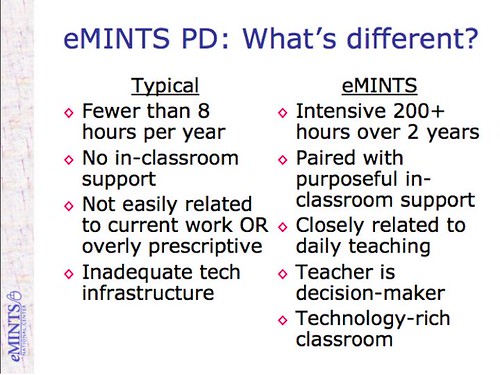
Research from eMints as well as other groups on professional development points to the need for school professional development models to change markedly. PD needs to be in cohorts, sustained, include follow-up and accountability, and supported locally with both technical and instructional support. The following slide is from an eMINTS presentation, which I have included in my “Global Education Conversation” presentation:
Almost every time I hear someone talk about ways to help teachers effectively utilize digital tools for learning, professional development comes up. I think we need to keep talking about the importance of PD and fighting for PD dollars in schools, but I also think we need to increasingly invite teachers to join the chorus of online collaborators in the edublogosphere whose PD is now more intense, sustained, just-in-time and challenging than ever before! We need to broaden the invitation for teachers to participate in K-12 Online, but also encourage DISTRICTS to formally get teachers involved with online professional development like this. Here in Oklahoma, even though we have lost our Discovery Education field manager, our DEN needs to continue to move forward– the DEN is a GREAT model, but I think it shouldn’t be connected exclusively to people who are customers for a commercial product, like UnitedStreaming. We need more peer-to-peer teacher professional development, and I hope we’ll see more efforts in the months ahead to advance those models of effective professional development.
Yes we need more money for teachers, and we need to keep pushing for that, but we also need to let more teachers know about the professional development opportunities which are available to everyone FREE online… and get more school districts to embrace and champion those opportunities as well.
Technorati Tags: education, educationreform
If you enjoyed this post and found it useful, subscribe to Wes’ free newsletter. Check out Wes’ video tutorial library, “Playing with Media.” Information about more ways to learn with Dr. Wesley Fryer are available on wesfryer.com/after.
On this day..
- Google Hangouts 101 and Sharing Lessons with Google Tools – 2014
- Playing with Media in Houston, Texas – 2011
- Education can empower us with skills to act upon the world – 2010
- Sketchcasting: A combination of blogging, talking and drawing! – 2010
- Lots of phone stalls, but not many phones! – 2010
- T3 Grant Notes (ARRA Stimulus funds for Educational Technology competitively released by the Texas Education Agency) – 2009
- Podstock Southwest in El Paso – 6-7 August 2009 – 2009
- Discussing GirlsGoGames.com – A conversation about values and media literacy – 2009
- Moodle as “the killer app” – 2008
- The benefits of unplugging – 2008
Comments
6 responses to “Professional development and professional learning networks are key”
Wes, you have been reading our minds over here in Qu̩bec. Professional development will be part of my new job responsibilities over at LEARN (learnquebec.ca) and we are in the process of putting together a needs assessment for the prof dev needs of all the teachers in the English sector of Qu̩bec. You make some excellent points in your post Рdo you have any research to back up the connection between prof dev time and improved performance? It makes intuitive sense and has certainly been my own experience, but it would be great to be able to point to some solid research as we make our needs assessment.
I made my own presentation to the Illinois Online Conference earlier this year about social networking and professional growth. Konrad Glogowski has made several presentations on this topic as well – most recently at the Webheads in Action ONline Convergence last month. Through the use of web 2.0 tools, a teacher can design a personal learning environment that is ongoing, sustainable, self-directed and self-regulated in a way that is optimized for their individual needs. The way I see it, our job as trainers of prof dev is to create a model for them to see the value of these tools and get on board with it. Accountability can easily be built in and measurement can take place over time. We are working on the creation of the assessment matrix that you mention. Not an easy task!
Once again, thank you for an excellent post and let’s keep in touch on this topic!
Wes – I agree with all that you say but here is the question I always have. Most of this is overwhelming to teachers. Where do they begin? I am a new Technology Director and I struggle with this every day. I have begun this conversation in my district – amazed at how foreign my language and ideas are to most! But again……..where do we begin? If I asked you what first three steps should a teacher take to begin to enter this new world of online learning (both for themselves and their students)……what three steps should they take? I find teachers are willing but often do not want to make choices. What should I be teaching? often means tell me what to do. I want to make it simple and guide them in small steps. In my workshops this summer I will guide them to:
Learn about RSS feeds (Google account – Blogger)
Google Alerts – (themselves and students)
Subscibe to two blogs (one of which will be yours)
Create a wiki or blog for their class (will explain both – they will choose and create)
I have 5 hour workshops and I think this will be a good start – not too much – but taking a big step into this new way of learning!
Would be interested to hear other thoughts about how to keep this simple, not overwhelm teachers, and yet begin to institute change! Your blog has guided my learning….thank you!
Wes, I certainly agree that the profile of PD needs to be raised to a higher priority in schools, districts and on state mandates. However I see there are two issues that we need to construct in future PD models. First, PD trainers must focus on meeting the teachers learning needs of their own curricular program, rather than on the tools themselves and then asking the question ” how can we apply this tool into our program”? All too often we see the application of a ‘one size fits all’ thinking.
Secondly there must be greater accountability of PD efforts at all levels. Without regard to the type of PD model applied, type of incentive offered, tools or resources utilized every PD plan must include standards for measuring performance improvement. By adding some form of benchmarking schools will be able to measure a continuum of success. In fact I believe we need to develop new instruments to measure performance improvement that is sustained by the teacher themselves.
I think Sharon’s follow-up response to your post hits the mark as well, as she states,” Through the use of web 2.0 tools, a teacher can design a personal learning environment that is ongoing, sustainable, self-directed and self-regulated in a way that is optimized for their individual needs.” She makes two key points which I wish to highlight; first PD must be personalized, focused on the needs of each individual teacher and secondly we are looking at optimizing a teachers potential, which enables a teacher to maximize their strengths and allows for improvement of skills required to perform their roles.
According to national statistics, there was 5.1B dollars earmarked for PD in American public schools. Rather than focus on incentives for administrators we need stronger collaboration to construct PD programs for all teachers, that is sustained, measured and Wes, I certainly agree that the profile of PD needs to be raised to a higher priority in schools, districts and on state mandates. However I see there are two issues that we need to construct in future PD models. First, PD trainers must focus on meeting the teachers learning needs of their own curricular program, rather than on the tools themselves and then asking the question ” how can we apply this tool into our program”? All too often we see the application of a ‘one size fits all’ thinking.
Secondly there must be greater accountability of PD efforts at all levels. Without regard to the type of PD model applied, type of incentive offered, tools or resources utlized every PD plan must inlcude standards for measuring performance improvement. By adding some form of benchmarking schools will be able to measure a continuum of success. In fact I beleive we need to develop new instruments to measure performance improvement that is sustained by the teacher themselves.
I think Sharon’s followup response to your post hits the mark as well, as she states,” Through the use of web 2.0 tools, a teacher can design a personal learning environment that is ongoing, sustainable, self-directed and self-regulated in a way that is optimized for their individual needs.” She makes two key points which I wish to highlight; first PD must be personalized, focused on the needs of each individual teacher and secondly we are looking at optimizing a teachers potential, which enables a teacher to maximize their strengths and allows for improvement of skills requried to perform their roles.
According to national statistics, there was 5.1B dollars earmarked for PD in Amercian public schools. Rather than focus on incentives for administrators we need stronger collaboration to construct meaningful PD programs for all teachers that is sustainable, measurable and meaningful, in order to transform classrooms.
Having in taught in one of those bottom of the barrel schools, I did not have time for professional development. Unlike the teachers in the ‘burbs, most of us had second jobs. Plus the amount of stress that comes with teaching in one of those school in unimaginable by anyone who does not teach there. No matter how bad teachers think they have it, until you find your self at one of the bottom schools in a city like New York, you simply cannot imagine how bad it is…let me rephrase that — how challenging it is. I actually stopped reading because I just could do something that reminded me of school! I had to decompress in a way that involved things that would not lead me to think about school. I couldn’t even go to museums on vacation! If I had gotten a bonus and been able to quit my second job, had enough money so that my family was not in financial stress, then I could have thought about professional development. I did move to the suburbs after ten years, and all I have done since then is absorb all the professional dev. I can find and have grown enormously as a teacher. I always think if I knew then what I know now what a different experience I would have had. Again, the chaos is unimaginable…and I tend to be an optimist. When you have to worry about fights, drugs, weapons, gangs, your car being broken into, your wallet being stolen, your salary being frozen for yet another year, zero supplies, a building that is in total disrepair, a non-existent administration….who would have time to worry about classroom 2.0.
Yikes…somehow ready this really brought back some repressed feelings about my experience. Don’t mean to be a downer, but it so much harder and more complicated than it seems from the outside.
It’s like the kid who comes hungry to school each day, you have to feed him before you can teach him.
I am not going to even re-read…sorry this comes off as abrasive or negative! : )
I agree with professional development. Teachers are important in children’s education, and the way they teach is a huge factor that must be considered. It’s only fair to provide hard working teacher with high pay.
I agree with Vincent regarding tools. It doesn’t have to be focused on the tools in making it work better, but on how teachers should teach in order to deliver a better message for the students to understand. Basic skills are their foundation and every teacher needs to be reminded about it.