
Last month, Ponca City Schools in Oklahoma faced a news headline any 1:1 laptop school could potentially confront in the local media: “Ponca City student accesses porn on school laptop.” According to the article:
A Ponca City mother is outraged. She says her son has been accessing pornography….on a laptop that was issued by the school….and she says school officials are partly to blame. “I was angry, I was really angry at first,” Judy Ferguson said. Judy found her teenage son watching pornography on his school laptop. “When I caught it I took the computer and turned it back in to the school,” Ferguson said.
Life is about choices, and students face a multitude of digital choices when they get online or connected with any device including a laptop, a phone, or other communication tool. This is one reason Oklahoma schools sending laptops home with students not only have parents sign an acceptable use agreement (AUP) addressing SHARED responsibility between parents, students and school officials for student use of technology equipment, they also hold parent training / information sessions when this specific issue is addressed. I’m not sure if Ponca City mother Judy Ferguson signed a form like that and attended an informational session about shared responsibility for student behavior on laptops, but she should have.

In the initial years of the Texas Immersion Pilot Project (TxTIP), I heard multiple stories from school officials about issues and incidents involving student access of pornography and inappropriate material. Any school employee involved in a 1:1 program knows this is an issue which must be addressed. The strange twist to this Ponca City Schools story was that school officials reportedly issued a laptop to the same student who previously got in trouble for accessing pornography right after Christmas break. Again according to the News4 article:
The Tech Director [of Ponca City Schools] said the software the school uses tracks every key stroke and they could see the student attempting to get into x-rated areas but their records show he was never able to access it. Ferguson became even more upset when the school gave her 9th grader another laptop after she requested he complete his assignments another way. School administrators admit that was a mistake. “When they came back from Christmas break inadvertently he was issued another laptop when that was discovered that second laptop was taken away,” Dr. David Pennington, Superintendent of Schools.
I’m wondering how school officials “inadvertently issued a laptop?” (I’m also wondering if they run key loggers on all school computers…) It would be great to see a school response with more information, background, and quotations on this than La’tasha Givins (the KFOR-TV reporter) provided for this article. It is reasonable to conclude the mother of the student saw her child accessing pornography at home: It is highly doubtful she would raise these embarrassing charges regarding her own son otherwise. Understanding this, the technology director’s response which denies inappropriate content was EVER accessed by the student on a school laptop seems unreasonable. Perhaps this was a misquote?
Responsibility for teen behavior when it comes to life online as well as offline lies primarily with the STUDENT. Yes, parents as well as educators share responsibility for guiding and supervising student actions. Ultimately, however, in our society we hold individuals responsible for their behavior rather than institutions. It would have been helpful (from a community education perspective) if reporter La’tasha Givins had provided some of this context. I’m not sure if school officials provided this or not.
When a high student chooses to have sex and gets pregnant, does the local TV affiliate run a segment blaming school officials? Hopefully not.
One takeaway from this article (and others like it which paint 1:1 laptop programs as evil / not worthwhile) is the importance of school officials “telling the story” of positive 1:1 learning impacts early, consistently, and through multiple media channels. In most school districts today, we have barely started to leverage the power of social media to ‘tell our story’ and communicate with parents as well as others in the community about the great things happening in our buildings each day. An example of why this is important is the result for a Google keyword search for “Ponca City laptop” today. Guess what link is the “non-promoted” search result #1?
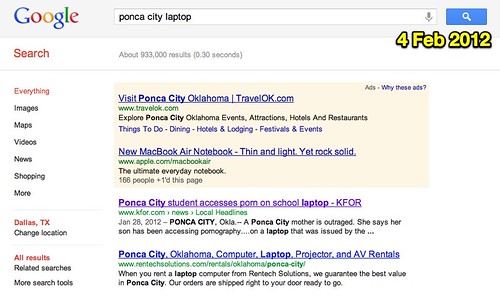
A second takeaway is the importance of school officials using consistent language with students, parents, members of the community, and media when it comes to laptop learning. We must emphasize “digital citizenship” and the responsibilities which we share to help students learn to make good choices.
Should Ponca City School officials have been more careful to not issue Judy Ferguson’ son another laptop computer after the Christmas holiday, since his mom had specifically asked that he NOT work on a laptop to complete his assignments? Probably. (I say that conditionally since I’m sure there is ‘more to this story.’)
Should KOFR reporter La’tasha Givins have ignored the fact that Judy Ferguson’ son CHOSE to find and look at pornography on a laptop of any kind? Absolutely not. Too many people in our society want to ‘pass the buck’ when it comes to responsibility, and the primary people responsible for these “inappropriate content access actions” were the STUDENT and the PARENT.
Yes, teachers and school officials share responsibility for helping students learn and learn to make good choices. We don’t “pass the buck” entirely to parents and students for everything which happens during school and in some cases, even for things which happen after school. Schools DO bear some responsibility for helping inform and support “good choices with laptops” when they send them home with students. Ultimately, however, “the buck should stop” with the student and the parent when it comes to inappropriate website access at home.
I hope La’tasha Givins will investigate these issues further and write a follow-up article which provides more context for this situation and the people as well as organizations who are involved.
Technorati Tags: city, laptop, ponca, ethics, responsibility, parent
If you enjoyed this post and found it useful, subscribe to Wes’ free newsletter. Check out Wes’ video tutorial library, “Playing with Media.” Information about more ways to learn with Dr. Wesley Fryer are available on wesfryer.com/after.
On this day..
- Great Class Castle Build in MinecraftEDU – 2015
- Cbus Flex-Gel iPad Cases: Fit Great in a Bretford iPad Cart – 2014
- Toffler on Feeling Overwhelmed (in 1980) – 2013
- Scratch Playing with Media Friday Meetup Cancelled (8 Feb 2013) – 2013
- Playing with FeedWordPress: Planning for the Classroom Newspaper of Now – 2013
- Individual vs Team Blogs for PreService Edu Students (Comparing KidBlog & EduBlogs) – 2011
- Dangerous Winter Temperatures – Snow in Houston! – 2011
- Ideas for a Google Reader Assignment? – 2011
- IMPACT Oklahoma Grant Workshop 2010 Notes – 2010
- A case study on why team blog MODERATION is essential in schools – 2010
Comments
7 responses to “Don’t Blame School Officials if Your Child Chooses to Look at Porn on His Laptop”
Hey Wes,
I’m not sure I would agree with a key logger on 1:1 laptops. Have you heard of other districts that do that? It seems like too much of an invasion of privacy. In this situation, mom attended an information session. It did not say where he accessed the inappropriate sites, but I’m pretty sure they were blocked at school. If it happened at home, it was mom’s responsibility to monitor the sites her son was going to, not the schools. I’m sure it was explained pretty clearly that there would be no filtering at home.
Taking away the computer for a child in a one to one school seems ridiculous. We don’t stop teaching a kid to read because he choose to look at an inappropriate magazine. We teach him responsible choices. The same thing should happen with computers. There should be consequences, of course – hopefully set up by the parent, but the school can chime in too. However, taking away the huge part of his learning at that school is just silly.
I also have big reservations about “key loggers” for 1:1 settings.
Puh-leeze.
Has this kid ever gone to a public library? Plenty of nudes there — sculptures, drawings; even the written word has been know to occasionally be suggestive.
What exactly is it that Ferguson wants her son protected from? How on earth would she deal with a trip to the mall where there is a constant and fairly unavoidable onslaught of Victoria’s Secret-like stores? And heaven forbid they venture inside of a 7-11 or any bookstore with magazines.
The boy was curious. Why can’t PC schools complain to KFOR that Ferguson was neglectful? The AUP clearly shows someone tried to educate the Fergusons.
Sad that nobody was around when he began seeking information on this forbidden topic. What a wonderful opportunity for a parent to explain the world and teach correct behavior about relationships and biology. Oh. And making good choices.
Well I don’t see how the school is to blame for it. I mean all technology provides us with are tools and it is entirely up to us to use them well.
[…] Moving at the Speed of Creativity – Don’t Blame School Officials if Your Child Chooses to Lo…–Life is about choices, and students face a multitude of digital choices when they get online or connected with any device including a laptop, a phone, or other communication tool. […]
I do agree that it was the student’s place to act responsibly. But, seriously, what 14-year-old boy isn’t going to look at porn, given the opportunity?