
Wordle is not only a fun site to use, it also can be an illuminating tool for learning in different contexts. Tag clouds are commonly used on social bookmarking websites like delicious.com and photo sharing sites like Flickr, but with Wordle anyone can create a “word cloud” about anything. According to the Wordle homepage:
Wordle is a toy for generating “word clouds” from text that you provide. The clouds give greater prominence to words that appear more frequently in the source text. You can tweak your clouds with different fonts, layouts, and color schemes. The images you create with Wordle are yours to use however you like. You can print them out, or save them to the Wordle gallery to share with your friends.
Note the third word in the predicate of this definition: “toy.” Use of this noun connotes an appropriate and intended purpose for many web 2.0 tools and websites which we as educators should heed more often: Play!
Before turning your students loose on the Wordle website, however, note the following warning and disclaimer from the site’s creator:
Wordle, as it stands, is inappropriate for classroom use. This is because I do not censor the content that appears on Wordle (I couldn’t possibly; there are thousands a week), and, therefore, it’s possible to find images in the public gallery that are entirely unsuitable for younger users. I regret this, and hope to address it some day, but that’s how it is for now.
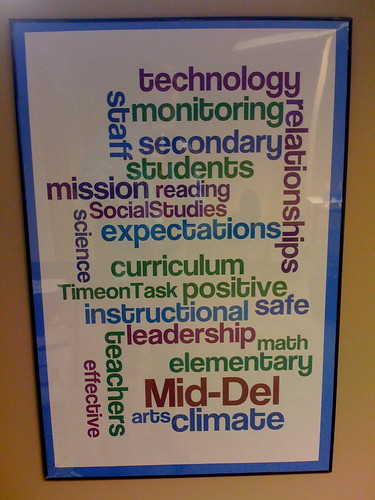
Two weeks ago I was in Mid-Del Public Schools for our Celebrate Oklahoma Voices partner’s workshop, and saw this great wordle poster describing priorities for the Mid-Del instructional technology department. This is on display in one of the district’s technology training labs equipped with dual-booting new 20″ iMacs:
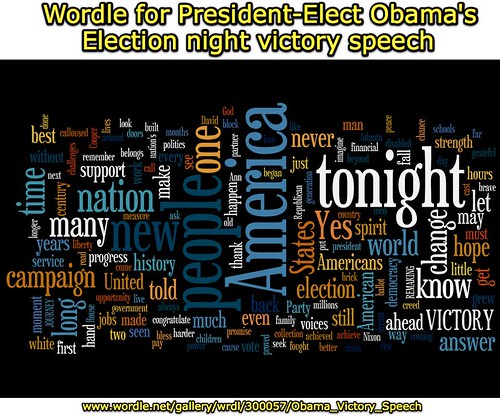
I like this Wordle of President-elect Obama’s election night victory speech:
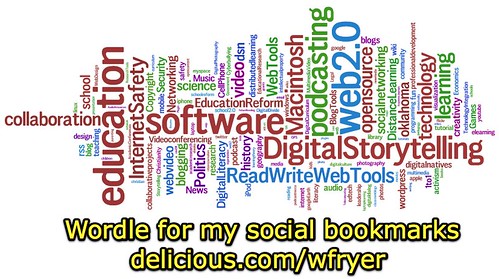
I used Wordle.net to create two word clouds this evening, one for my own delicious social bookmarks:
…and another for my last 30 blog posts, which are included in my feedburner blog feed:
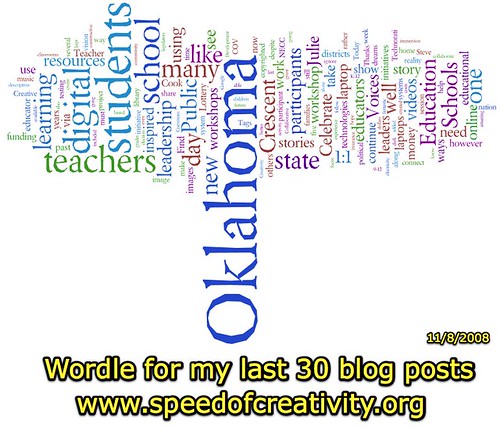
Until seeing this Wordle cloud, I didn’t realize just how much I’m writing about and referencing Oklahoma these days! 🙂
Wordle is a great example of a web 2.0 visual tool which should be of interest to large numbers of teachers in multiple contexts. Wordle can not only be used to explore, it also can disclose patterns and help communicate ideas visually in powerful ways which can be much more difficult or time consuming when we constrain ourselves to only traditional, text-based tools.
I took my son to Home Depot today so we could purchase some small pieces of plywood for him to use in making a hornbook next week in his 5th grade social studies class. According to the current English WikiPedia article for “hornbook:”
A hornbook is a book that serves as primer for study. The hornbook originated in England in 1450. The term has been applied to a few different study materials in different fields. In children’s education, in the years before modern education materials were used, it referred to a leaf or page containing the alphabet, religious materials, etc., covered with a sheet of transparent horn and fixed in a frame with a handle. In United States Law, a hornbook is a text that gives an overview of a particular area of law.
According to the worksheet Alexander brought home for school showing the dimensions of the plywood he needs to make a hornbook, hornbooks were “the first books used in the New England colonies.”
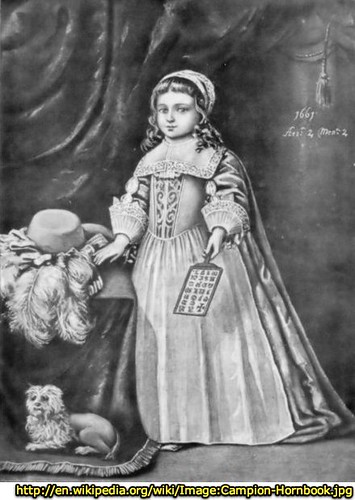
It is mind boggling to consider the differences in power and potential represented by a hornbook on the one hand, and my son’s laptop computer connected to the Internet on the other. Will he be introduced to the power and possibilities of analyzing digital texts at school this year using Wordle? I doubt it. None-the-less, he SHOULD (with supervision) be introduced to this powerful tool, and so should all the teachers in our classrooms.
Here’s a Wordle I created using the RSS feed for blog posts by Alexander on our family learning blog, “Learning Signs.”
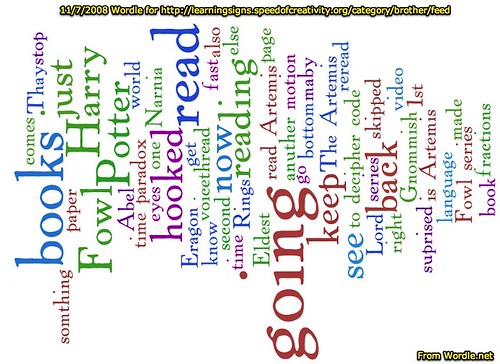
Could a tool like Wordle and a digital writing environment like a moderated blog be at all relevant as my son seeks to develop his own writing skills in advance of our state’s 5th grade writing test this coming spring, and as he develops skills as a literate communicator and citizen? Most definitely. What are the comparative potential benefits, from a literacy standpoint, of my son creating a hornbook or being encouraged to write and analyze his own writings using a blog and Wordle? Probably pretty stark.
Authentic learning is so much more than simply “filling a pail.” Real learning is about exploration, discovery, play, and surprise. When is the last time you were surprised in your own journey of learning? With tools like Wordle at our fingertips, opportunities for surprises abound. If you haven’t already, give Wordle a spin and then make it a point to share Wordle with someone else at school or work next week.
What have you learned or discovered with Wordle lately?
Technorati Tags:
wordle, learning, discovery, education
Note: As of 1 Oct 2026, this is a FULL STATIC COPY of all 6,390 posts shared on this blog since 2003. Updated content and ideas from Wes Fryer are still available!
Comments
10 responses to “Exploring, Learning and Communicating with Wordle”
I love Wordle, I’ve found it’s a wonderful introduction for students to digital story writing. I included it on http://www.thedigitalnarrative.com earlier in the year as an introductory exercise for those teachers wishing to explore digital narrative in the classroom.
http://www.thedigitalnarrative.com/teachign%20method%20lessons/warmups.htm
Using colors and manipulating the direction of your content, you can explore more fluid forms of story writing. Does the color influence the meaning? How do alternate shapes in your Wordle affect your digital narrative.
I’ve also had great success with students building stories using online mindmapping tool bubbl.us. It’s also very suitable site for introducing alternate forms of story writing to a classroom.
http://www.thedigitalnarrative.com/teachign%20method%20lessons/bubblus.htm
With bubbl.us you can explore shapes and colors in much the same way, but with a greater scope I think.
Importantly, there’s not initial need to register for either Wordle, or bubbl.us … which makes them easier to introduce it to the classroom.
Cheers
Martin J
As a teacher of upper elementary gifted students, both my students and I really like wordle – what a great combination of literacy and visual literacy. My students picked topics they wanted to explore, developed a related vocabularies for those topics and produced Wordle’s for their respective Wiki pages – We are also showcasing our work – here is a sample of their content-connected Wordles – http://weewebwonders.synthasite.com/worlde.php
I really enjoyed this post. I love Wordle and can see lots of ways to use in the classroom even if there may be inappropriate Wordles in the gallery. I like the mixing of literacy and visuals. I also LOVE to play with the Wordle by changing the colors, the horizontal/vertical ratio, and font.
Play is not just for kids according to Dan Pink in A Whole New Mind. A great quote from that book is “The opposite of play isn’t work. It’s depression. To play is to act out and be willful, exultant and committed as if one is assured of one’s prospects.” –Brian Sutton-Smith professor emeritus of Education at the Univ. of Pennsylvania. Playing with the words in Wordle from speeches, our tag clouds, and just lists of words is a great way to be exultant about vocabulary and words themselves.
Laurie Fowler
Tuscaloosa, AL
PS I am leaving this comment as part of Steve Dembo’s 30 Days to Being a Better Blogger. 🙂
“The opposite of play isn’t work. It’s depression. To play is to act out and be willful, exultant and committed as if one is assured of one’s prospects.” –Brian Sutton
Great quote!
My tech kids had fun with wordle. They used it to examine some writing they had done for socials class and used the word cloud to look at word choice. Students then modified the text, changing the more frequently occurring words, and created a second wordle cloud. The resulting text was then placed within a glogster poster. Worked quite well.
I’ve actually used Wordle to create signs for my office at the middle school and high school using words to describe my position as instructional technology specialist. Great post!
So fun! Thanks!
I’ve used Wordle as reading tool ever since I read a post on Box of Tricks about it. Before reading an article, I copy the text into Wordle, create a word cloud, and then have the students predict what they think the article will be about. After we read the article, we reflect on our original predictions and make revisions as necessary. Sometimes as an alternative, we’ll make our own Wordles after reading a story. For that activity, the students have to decide what they feel are the most important ideas, words, and phrases from the story in order to make a Wordle. It’s a great way (and fun!) way to teach main ideas and supporting details—in a way that feels like play!
I’m excited to try using Wordle as a tool to analyze their writing. Will it pick up on their overuse of a specific word (“then,” for example) or would common, high frequency words be filtered out of the word cloud?
I love learning and I love that you said learning is is about exploration, discovery, play, and surprise. I truly believe that learning is all those things. It can be so fun. Growing, schools was a chore, but I feel like with my kids, I am making it an adventure.
We just started spanish (preschooler age) with this great bilingual book that is in both english and mexican spanish. Really cute. Anyway, whoever can use the most spanish words in a day that we learned, gets to pick the books to read that night. It is a lot of fun and they are loving it.
side note: It is a really cute book – “Tim and Kim” by Kay Linda Nord. Nord grew up in a bilingual home and wrote this for her son. Great personal story and children’s book. If interesed, this is where I found it: http://kaylindanord.com/
Thanks for the post on Wordle!