
This is a clear example of educational public relations “spin” in my home state of Oklahoma if I’ve ever seen it. Yesterday’s NewsOK article “Oklahoma education system improving, study says” starts with two sentences which misleadingly suggest things are good for education in our state:
The education system in Oklahoma is getting better but still needs improvement, according to a national study released Wednesday. Oklahoma was ranked the 26th best education system in the Education Weekly magazine 2009 “Quality Counts” survey. The state moved up two spots from 28th in 2008, according to the state Department of Education.
This doesn’t sound fantastic, but it doesn’t sound terrible either, right? Wrong, read the rest of the article and reconsider your initial reaction. At the bottom of the article in the final sentence we read:
Oklahoma scored best [IN THE UNITED STATES IN THIS STUDY] in the standards and assessments category with a grade of A+. The state scored the worst in the K-12 achievement category with a grade of D.
Worst in K-12 achievement? And is K-12 achievement something we should consider important as we ask the reasonable question, “Are our schools improving?” Of course it is important to consider. Yet our state school superintendent’s quotation in the article apparently overlooks this inconvenient statistic and finding:
“The bottom line is we’re moving forward, and this annual study recognizes that,” said State Superintendent Sandy Garrett in a statement.
When Oklahoma is first in “standards and assessments” and last in “K-12 achievement” (according to this study) I don’t think I’m going out on a limb to question the assertion that “we’re moving forward.” What sort of educational future are we moving towards together as Oklahomans, exactly, when our leaders are excited about “standards and assessments” but fail to mention a HORRIBLE rating for K-12 student achievement?
As we sadly find in many other mainstream news articles about “educational quality” and “comparative scores,” in this one author Carrie Coppernoll didn’t bother to provide a link to the original research article or study, so discerning readers can readily get more background information on what these findings might actually mean. How was our state’s performance on “standards and assessments” measured, as well as “K-12 achievement?” Was achievement measured by a fairly valid and reliable instrument like NAEP or something else? Without doing some ancillary web searching on our own, there’s no way to tell from Carrie’s article.
The Education Week article and report referenced in Carrie Coppernoll’s article is “50-State Report Card: Amid national political turnover and financial worries, states remain on the front line in the push for school improvement.” Here is a screenshot of the interactive scorecard for Oklahoma, showing a breakdown in how our state fared in this assessment:
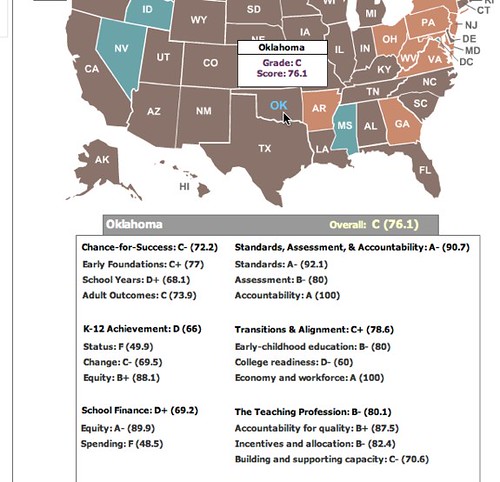
Let’s start a brief analysis of these numbers by looking at the lowest scores. You’d think, based on what Carrie Coppernoll wrote in her article, that a “D” was the worst score Oklahoma received in this comparative assessment. If you did, you thought wrong. Look closely at the data above. There are TWO “F’s” for Oklahoma for “status” under “K-12 Achievement” as well as “Spending” under “School Finance.”
Having access to this EdWeek article as well as these numbers broken down by category for Oklahoma, I still have VERY LITTLE idea what all of these statistics mean! I can certainly tell that my state is doing MUCH worse than the NewsOK article headline and text suggested. HOW is student achievement being measured here? I don’t know. I want to see a reasonably succinct video by someone, explaining what each of these scores mean in the context of Oklahoma. Otherwise, this news article and this report in general remain a perfect but sad example of the blind faith with which many members of our society view charts and graphs published by the mainstream media, which Neil Postman addressed in his book “Technopoly: the Surrender of Culture to Technology.”
As if these failures to accurately represent the findings of this study to the people of Oklahoma in the mainstream media were not enough of an affront, let’s consider the message of our Oklahoma state superintendent and what this national assessment shows we ARE (allegedly) doing a good job on when it comes to education. As Carrie did accurately identify in her article, our highest ranked category is for “Standards, Assessment, and Accountability.” Let me ask a basic and straightfoward question, which we sadly do not hear about in the mainstream press: Who is happiest about this result for Oklahoma education?
The likely answer? One company. Pearson. I’d like to see an in-depth article about the number of dollars we have spent as Oklahoma taxpayers in the last decade which has gone directly into the pockets of the Pearson corporation, since they became responsible for the educational testing of K-12 students in our state and many others. Then perhaps a courageous reporter could even follow that money trail. What would they find? I don’t know exactly. What I DO know is that like many other states around our nation, Oklahoma continues to waste a ridiculous amount of money on computer-based summative assessments, and there is a REAL cost for our students, our state, and our collective future.
Please don’t be decived by the NewsOK headline, “Oklahoma education system improving, study says.” Carrie Coppernoll, you should be ashamed of yourself for publishing such a misleading article with a blatantly false title. My brief reading of the report’s executive summary tells me this report says VERY LITTLE is improving in Oklahoma education if we choose to believe the metrics used by this report based on the “Editorial Projects in Education Research Center’s annual state policy survey.” If all we’re improving on is testing our kids more and better, than I don’t think I’m alone as a taxpayer, citizen, parent and educator in questioning the value of that trend. We’re killing the natural curiosity and love of learning in the classroom with high stakes testing now in many cases. This is absolutely the wrong educational path for our state and our nation.
Ultimately, reports like these DO tell us things about our educational system, but they do NOT tell us many of the things we need to know. What we need to know as taxpayers, voters, parents, educators, and concerned members of our communities is how to HELP teachers, principals, and students. I guarantee a stronger focus on accountability and standards is NOT “the way forward.” In fact, that’s the way backward.
I’ll close with a link to a very powerful and important presentation I heard Dr. David Berliner share several years ago, when I was working on staff at Texas Tech University in the College of Education. I found a link to the enhanced podcast version of this presentation tonight as I wrangled a bit more with Mobile Me. From April 2006, I titled this podcast presentation “High Stakes Testing is the Enemy.” The official title of his address was “Troubles for the NCLB Act: It may not be improving achievement and it corrupts the profession.” An audio-only version with shownote links is also available.
D’s and F’s are NOT “good enough” or “improving scores” for our children or for our state when it comes to our education system. We need some big changes in Oklahoma schools. Sadly, this article by Carrie Coppernoll provided a misleading message to the citizens of Oklahoma.
We need to do better.
If you enjoyed this post and found it useful, subscribe to Wes’ free newsletter. Check out Wes’ video tutorial library, “Playing with Media.” Information about more ways to learn with Dr. Wesley Fryer are available on wesfryer.com/after.
On this day..
- Embed Twitter Widget in Dot Net Nuke (DNN) Website – 2015
- Disadvantages of Openly Sharing Media – 2014
- Yukon Students Learning Computer Programming with Scratch – 2013
- Introduction to the Common Core State Standards by Karen Robertson – 2012
- An Iterative Google Search (with advanced options) solves a MS Word File Saving Problem – 2012
- Learning about Glass Blowing in Santa Fe, New Mexico (videos) – 2011
- Good Memories from Denton and UNT – 2011
- Virtual DNA Fingerprinting Lab (1 to 1 Learning in Yarmouth, Maine) – 2011
- Brainstorm & Find Available Websites with DomainStorm – 2011
- Getting Creative with Windows Live Movie Maker on a Netbook – 2010
Comments
4 responses to “Since when is a “D” Grade considered good and improving in Oklahoma?”
My first thought after reading this was what an interesting language arts/math project this would make – beginning with the article you are citing, and ending with a analyzed, well reasoned blog post like this one. But that’s beside the point. Our state has rags that publish these seemingly commanding and all knowing proclamations, which upon closer inspection have no basis in reality or sense. Anyone who is involved in the field of education knows how malleable terms like “testing”,”grading”, “scores”, “assessments”, “achievement”, and “accountability” can be. They are useful political words. They are words that we thought at one time we understood, but which have really just become jargon. Attach some numbers to them and they can be used to supplement budgets, placate school boards, and forward political agendas.
Some of these statistics are laughable! Their K-12 achievement is an F, but at least it’s equitably so. I guess that means everyone got an equal failure? And they do a great job writing tests and scoring them (assessments and accountability) but not a great job educating school age children nor getting them ready for college (both D grades) But, once they start working, they’re all A’s?
Aack! Gobbledegook!
Another point that doesn’t make sense for me is the relationship between the Teaching Profession score of B- and the K-12 Achievement score of D. Oklahoma has one of the higher number of National Board Certified Teachers by state. The state superintendent happily boasts of this. But why has the improvement in teacher quality not translated into better student achievement for Oklahoma students? I realize many of these teachers leave Oklahoma for higher paying jobs in other states but some do stay.
Most parents in Oklahoma hear or read through the media outlets about these “improvements” and erroneously feel like their children are improving. It scares me that they accept all of this as fact. I don’t know what the solution is for improving the educational system. We have a lot of work to do. The “leaders” don’t seem to understand that there is a problem. Parents accept the media’s good news and don’t dig any deeper.
[…] think the answer is the same as I cited in my reference to online testing beneficiaries in the post “Since when is a “D” Grade considered good and improving in Oklahoma?” from last week. Pearson. I’d hypothesize they love the fact individual states continue to pay […]