
This evening my 7th grade daughter worked on an assignment for one of her classes: Copying verbatim an entire chapter of her textbook. This is not acceptable.
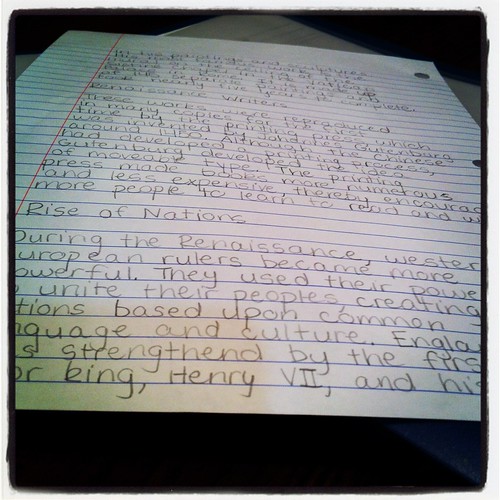
I’m emailing the teacher to meet with him, to discuss this and some other issues, and I’ll meet with him face-to-face (I’m sure) in the next two weeks. I’ll also likely share this concern in writing with the school administration. I really like this teacher, who taught my son last year. The class my daughter is taking with him is a new course for him to teach this year, and I know there are some challenging circumstances surrounding it. (He learned just before school started he’d be teaching this course.)
No matter what the circumstances, however, simply making students copy entire chapters of their textbook (re-writing them in their own handwriting) is a terrible assignment and shouldn’t be acceptable at ANY school.
Our transition to Common Core State Standards as well as changes in textbooks at several grades are laying bare some BIG problems we have in our classrooms with basic instruction, lesson design, pedagogy, assessments, and assignments for students. Many teachers consider the textbook to be their curriculum. That is not the case and shouldn’t be the case, but for many teachers it is. That’s why in some cases, when the textbook changes or is no longer available, teachers freak out. “What am I going to teach?” “I don’t know what to do now that we don’t have a textbook!” These are common refrains in many Oklahoma classrooms today. In the situation I’m depicting with the image in this post, the teacher and students DO have a textbook, but unfortunately it is (apparently) the exclusive academic focus.
In Yukon Public Schools, where I’m working again this semester (on a contract) as an “Innovative Instructional Coach,” principals and teachers are studying Robert Marzano’s book, “The Art and Science of Teaching.” I’ve started the book but haven’t finished, so I can’t share a complete review of it, but I do like the focus on essential questions and lesson objectives. This is a fundamental starting point for classroom lessons. Saying “Our objective is Chapter 2 in our textbook” doesn’t cut it.
We have important and challenging work to do in our schools to improve the quality of instruction and provide engaging learning opportunities for our students. We have lots of work to do both in pre-service teacher education as well as in-service teacher ed. I deeply regret that as voters, we’ve allowed our elected representatives to focus teacher, student, parent, and administrator attention on unproven and (in many cases) destructive educational policies like high-stakes accountability. Please take a few minutes to read Diane Ravitch‘s February 2012 post on NiemanWatchdog.org, “Do politicians know anything at all about schools and education? Anything?” Unfortunately most don’t.
The fact that recent and current educational reforms (sadly continued under President Obama’s “Hope for Change” administration) aren’t productive does NOT mean the status quo in education is good or acceptable, however. We DO need to improve, and as professional educators who do our research we CAN ascertain the strategies and changes we need in our classrooms. The most basic ingredient we need in each classroom is a GREAT teacher who is a LEARNER and is continually working to improve. I’m betting that’s the case with Sarah’s teacher who had her copy a textbook chapter for homework tonight. The resources available to him to teach this class and teach it well are very limited, I’m sure, but hopefully we can figure out some ways to make the situation better together.
Telling students to “copy chapter 5” for tonight’s homework is as bad as saying, “page 20, 1 through 21, odd” and pretending like we’ve taught. Neither assignment by itself constitutes “teaching” or providing an educative experience for students. Hopefully the schools where you teach and work, and/or where your children or grandchildren attend, aren’t facing challenges like the ones I’ve described here. More than likely, however, they are… at least to some extent.
Testing isn’t teaching. Making students copy entire chapters out of their textbook as “a regular weekday assignment” isn’t acceptable teaching, either.
Technorati Tags: ccss, common, core, design, marzano, teach, teaching, textbook, copying
If you enjoyed this post and found it useful, subscribe to Wes’ free newsletter. Check out Wes’ video tutorial library, “Playing with Media.” Information about more ways to learn with Dr. Wesley Fryer are available on wesfryer.com/after.
On this day..
- Tips for Using Jamboard – 2022
- Provide Family Tech Support FREE with Teamviewer – 2020
- Teaching iPad Videography From 3800 Miles Away – 2014
- New Video Editing Options with YouTube’s Browser-based Editor and Magisto – 2011
- Making the Case for Sharing Curriculum Openly Online – 2011
- Radio Program for Playing with Media? – 2011
- World Expo Shanghai (a VoiceThread digital story) – 2010
- Create animated cartoon videos with GoAnimate #learning2cn – 2010
- Takeaways from the 21st Century Learning @ Hong Kong Conference – 2009
- New South Wales: The One to Watch as a Scaled 1:1 Deployment – 2009
Comments
14 responses to “Copying the Textbook is NOT an Acceptable Assignment”
That is, simply put… sad for our profession. That isn’t just a lousy assignment in 2012, that is a lousy assignment at any time in our history.
I ask my senior students work on a chapter summary from our main topic text-book for homework. They are divided up into small study-teams, each using a GoogleDoc shared document for each chapter, dividing up the task and questions amongst themselves. I track the updates and progressively post comments to reflect upon or answer. I only want a summary annotated with personal reflections and notes. As I explained, this is about engagement with the topic, demonstrating deep thinking about the issues and questions raised, supplemented with external resource links and notes.
It is certainly not a verbatim, handwritten copy.
[…] who chose to look at it, but I find that I am becoming more and more comfortable with it. In the most recent post by Fryer, he talks about how there are many teachers who base their class off of the textbook and view it as […]
I agree with you. Students shouldn’t have to copy a whole chapter for a homework assignment, their not learning anything by doing it and the teacher is getting off easy. If they were to outline the chapter the student and teacher both would benefit form it. He should also inform his class about plagiarism, because i have friends who still do not cite their references.
I have a hard time understanding why teachers give assignments like this. I had a teacher in school who made students copy pages out of the dictionary or encyclopedia in detention as a punishment, so it’s hard to abstract any redeemable learning goals from a task like this. I would be interested to hear what the teacher has to say about his rationale for this activity. My guess is that he was not trying to punish the kids, and perhaps his objective was well-intentioned yet misguided. With some proper guidance, he could have articulated what he hoped to achieve from this lesson and been given suggestions for a better way to do it. This is a case of the kind of thing that happens when teachers work in a silo. If there was even a little bit of peer review going on, someone would have likely advised him to re-think this idea. I do hope you will write a follow-up to your discussion.
Reading this post makes my heart sink. Here in Australia we are at the end of Term 3 of 4 school terms – which this year marks the end of my son’s primary schooling years and 2013 is a move to high school. As a teacher, it tears me apart to write that he hates school – that each day he has to walk into a space that he sees as disconnected from learning rather than a gateway to it! A space filled with many teachers who still force children to “write lines” as punishment and “sit silently cross-legged on the floor” as punishment for having an overdue book!
He hopes that high school will be different – so do I, because my frustration levels are fever pitched and if he isn’t offered a 21st century education when he arrives in high school, then someone is going to hear about it! The line in the sand is drawn!
[…] with permission This evening my (Wesley Fryer, Moving at the Speed of Creativity) 7th grade daughter worked on an assignment for one of her classes: Copying verbatim an entire […]
I hope this is a big miscommunication. I have a hard time believing an experienced teacher would actually assign this as a stand-alone activity.
Wow, and I thought THIS was bad: http://dangerouslyirrelevant.org/2007/10/2nd-grade-tediu.html
Yes the assignment is not the greatest actually sad… would bother me as a parent as well. Only part that I wonder about was this posted after the meeting, email, communication with the teacher?
Oh wow! This reminded me of my first teaching job 35 years ago: a French teacher in a grade 7-12 school in rural Saskatchewan, Canada. Just some background: this school had gone through 7 French teachers in 6 years (I was the 7th). One of my grade 8 classes had a great number of students with learning difficulties. I eventually pulled out an old French text and had students copy out the lessons. Strangely enough, it “worked”. This was a group of kids that really liked repetitive and predictable work. I taught them ELA the next year; they much preferred the very strict grammar instruction with lots of note taking and structured activities to anything involving the study of literature. I’ve never done anything like this since. I did, however, manage to stay teaching French in that community for 3 years!
While I agree that this assignment is not worthwhile nor appropriate the comments about the text book are probably off base. Common core standards in general simply shuffle the main concepts around and reword them. If the book is the SOLE source of information, activities and lessons the teacher is quite likely struggling or lazy. Many teachers in my building don’t use our textbooks. The reason- they have their lessons and activities planned around the format they did when they began teaching. I am not saying that they don’t change things and update things but at the same time consider this – when textbook revisions come around and new texts are chosen, it is MORE work to use the new textbook. The textbook is a tool. An expensive one at that. College profs are notorious for this. I must assign a text but you don’t need to buy it. I disputed a test question in a comparative embryology course in college. I showed him that the answer I gave was in the text….his response “but I didn’t tell you that” . One can ignore the text out of arrogance and laziness just as one can use it for incorrectly as well. Textbooks are tools.
Are you sure this wasn’t a consequence for poor behavior instead of an assignment? Maybe your child didn’t want to say…? I know teachers who do this for a punishment, thinking that this way the child is at least learning something while hating the writing…which really no one should teach children to hate writing…but it is better than a detention…
I met with the teacher. No, this wasn’t a case of Sarah getting punished for poor behavior.