
I am continuing to read “Flow: The Psychology of Optimal Experience” by Mihaly Csikszentmihalyi, and am seeing lots of connections for educators and learners. At the outset of chapter 4, Csikszentmihalyi summarizes the “common characteristics of optimal experience” or flow:
- …a sense that one’s skills are adequate to cope with the challenges at hand, in a goal-directed, rule-bound action system that provides clear clues as to how well one is performing.
- Concentration is so intense that there is no attention left over to think about anything irrelevant, or to worry about problems.
- Self-consciousness disappears, and the sense of time becomes distorted.
- An activity that produces such experiences is so gratifying that people are willing to do it for its own sake, with little concern for what they will get out of it, even when it is difficult, or dangerous.
For me, I think reading, writing, blogging and podcasting have often come to constitute a “flow experience.” For that reason, it has been very difficult to embark on a 40 day fast of evening technology use! This experience is proving to be worthwhile, but certainly challenging.
The following graph of page 74 of Csikszentmihalyi’s book communicates a great deal about the conditions required for a flow experience and the dynamical nature of flow:
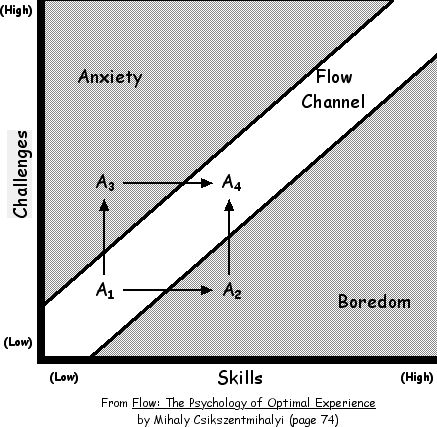
As we think about the need to engage students in authentic learning experiences inside and outside of school and the conditions of “engagement,” I think this graph and these ideas about “flow” are helpful. As a learner, I am intrinsically motivated to seek conditiions of flow. Csikszentmihalyi identifies “skills” and “challenges” as the two key variables in the flow experience, placing them on the respective X and Y axes of this graph. As my skills (and knowledge) in a particular area grow, I will naturally move out of the flow channel if the level of challenge I am facing remains static. This is shown on the graph by the movement from position A1 to A2. This condition leads to boredom.
If I do not increase my knowledge and skills but the challenges I face increase, I will experience anxiety: This is shown on the graph as the movement from A1 to A3. When we have students in our classrooms facing anxiety, I think this graph may be descriptive of their psychological experience.
As classroom teacher-leaders, I think it is helpful to think about the PERCEPTIONS of skills and challenges that the learners in our care have in given contexts. I think as teacher-leaders, one of our educational objectives should be helping students experience and maintain conditions of “flow” in their own learning. Is this idealistic? Of course. But I think the ideas Csikszentmihalyi is highlighting here in terms of “optimal experience” relate directly to the sort of authentic, meaningful learning experiences that both cannot be faked and are likely to be recorded in LONG TERM memory which we should actively promote inside and outside our classrooms.
Everything we do in school or outside of school may not be able to constitute a “flow” experience, but it is interesting to note that our perceptions of events and contexts are of primary importance in the flow experience. As learners, we can learn to shape our perceptions of consciousness and thereby shape with greater levels of control our own experiences inside “the flow channel.” This may sound like psychological mumbo-jumbo to some, but I think there is a GREAT deal of validity in these ideas. I have not finished the book yet (I’m just about one-fourth of the way through it) but I’m sure I’ll continue to see more connections to the learning process as I read more. Csikszentmihalyi’s view of learning seems to fit well with my own conceptions of “dynamical learning” that I’ve written and presented about previously.
Writing and blogging about what I am reading is an important part of my own effort to “own” these ideas and keep them within my own consiousness– both consciously and subconsciously. It’s amazing how the more we read, talk about, and write about ideas– our minds continue to process and develop those thoughts into new syntheses.
It’s Thanksgiving, and I’m thankful for MANY things– but one thing I’m very thankful for is the opportunity to have access to such rich texts and ideas both in book and electronic form, to think, talk and write about those ideas, and the chance to publish my thoughts here and elsewhere to invite your feedback and ideas! Thoughts like these from Csikszentmihalyi continue to increase my perceived level of “challenges” on the flow graph, and provide incentive to improve my cognitive skill set to understand and apply those ideas within my own worldview. I’m guessing this may explain (at least in part) the reason you’re here, reading this blog post!
Happy Thanksgiving! 🙂
(And for more info on “flow” if you don’t have one of Csikszentmihalyi’s books, you can check out the WikiPedia entry on this topic!)
If you enjoyed this post and found it useful, subscribe to Wes’ free newsletter. Check out Wes’ video tutorial library, “Playing with Media.” Information about more ways to learn with Dr. Wesley Fryer are available on wesfryer.com/after.
On this day..
- Inspired by National Geographic Explorer Andres Ruzo – 2019
- SmartPhones to Consider Besides the iPhone – 2016
- Lessons Learned: Hosting & Leading Local Technology Integration Workshops – 2012
- WordPress CSS Help Needed – 2011
- Comparing iPad PDF readers for annotation #edapp – 2010
- Take care of your laptop! (TPI: ThinkPad Investigation) – 2010
- Our need for systemic finance changes in US government – 2010
- Be sure comment moderation is turned ON for your school website – 2010
- Before The Battle of Hoth (Lego Stopmotion) – 2010
- New Mobile Photo Sharing Options – 2010
Comments
7 responses to “Flow, curiosity, and engaging education”
I completely agree with your analysis of the chart and the information you have gathered so far in your reading. I believe that the more we study the behavior and reactions of our children in their educational development, the more specifically we can address their individual needs. The balance between anxiety and boredom can be extremely difficult to find for each student, but that is the idea, right?
I also agree that this Thanksgiving we should be grateful for the small blessing of studies that can enhance our relationship with our students and help them to develop the confidence needed to be successful.
Thank you Wesley for the inspiring post and sharing with us some of your readings. I’d say flow is a very intense personal experience and it is provoked by our own desire to discover or go deeper into something that interests us.
It is difficult to provoke it from outside at a given moment just at the click of your finger. You do not control or command engagement.
Teachers should in reality allow spaces and time for flow to happen.
[…] I saw this quotation today on Mike Temple’s blog, and was reminded of the reading and thinking I’ve been doing lately related to flow and learning: Children, taught either years beneath their intelligence or miles wide of relevance to it, or both: their intelligence becomes hopelessly bewildered, drawn off its centers, bored, or atrophied.- James Agee Listen to this blog post as a mp3 audio file […]
Hi Wesley,
Dr. John Cuthell and I have been researching flow as a part of a larger international ethnographic study on child development and computers. Here’s a link to a article where we briefly talk about flow.
http://terry-freedman.org.uk/artman/publish/printer_714.php
Kind Regards,
Mechelle
[…] Speed of Creativity – Flow, Curiosity, and Engaging Education – Wes Fryer on ‘flow’ and optimal experience. He includes a great diagram (I like diagrams!) […]
What I read in this is when the skills level is growing and the challenge remains the same you find yourself bored. It’s interesting, isn’t it? Does it mean that the more people have experienced “flow” (which is a highly pleasurable state – for me), the more they will need it, the more restless they would become as they will constantly seek challenging situations? Is this why I keep finding myself in more and more challenging situations? Will it lead (as does the Peter Principle) to a level of incompetence? Can a teacher “afford” it ethically?
I came about your site quite circuitously, and being a science teacher, quickly checked out your science posts. I really enjoy the ideas of M. Csikszentmihalyi, and see many connections between his ideas and the learning process. In fact, I wrote an entry on the subject myself.
http://www.mytko.org/2006/11/going-with-flow_11.html
I also connect Csikszentmihalyi’s ideas to the practice of differentiation in the classroom. Since flow is such an individual balance, it requires individualized instruction. This is one of the most difficult, yet most rewarding, aspects of my job. Flow is tough to acheive in a typical public school setting….